

Essential Criteria for Qualifying Non-EU Employees Under Belgian Work Permit Standards
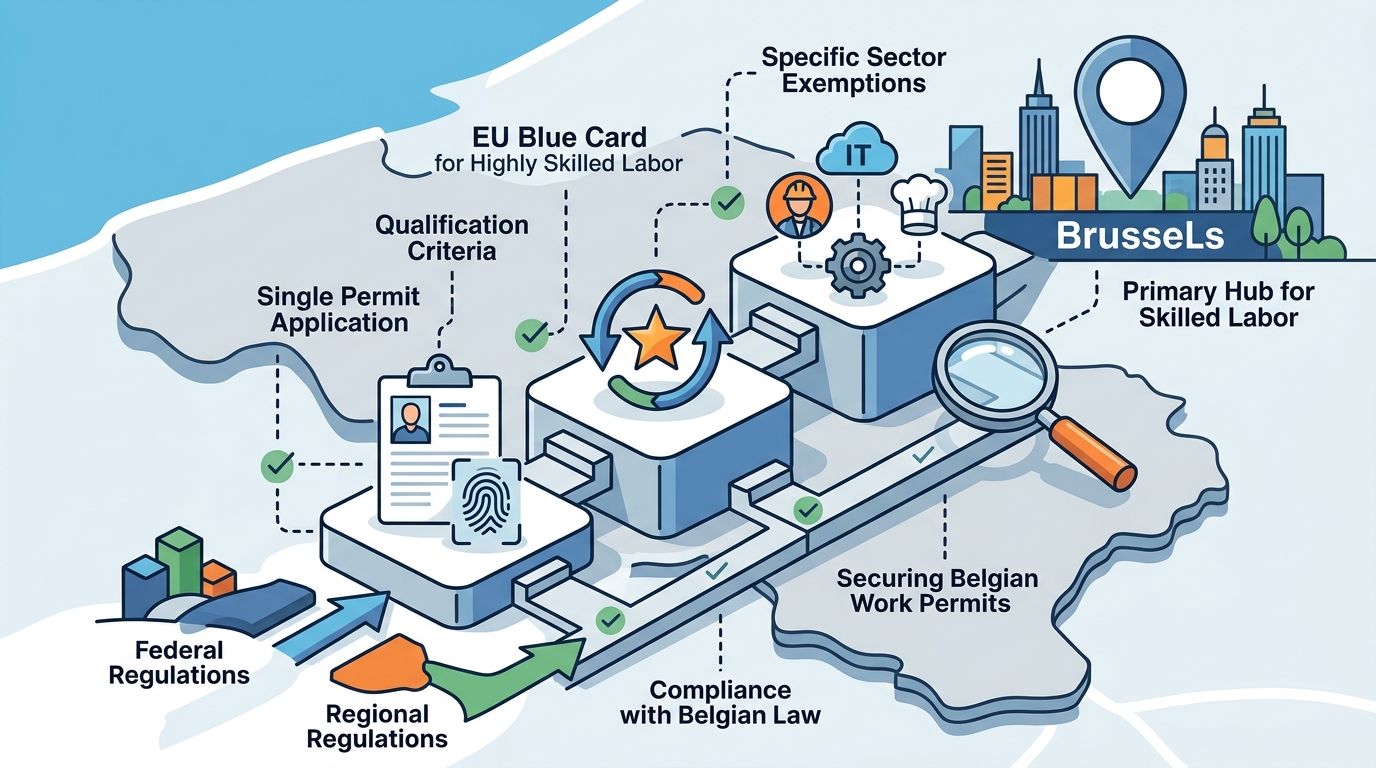
Navigating the Belgian labor market for international talent requires precise adherence to federal and regional regulations. According to recent data from the Federal Public Service Economy, Belgium continues to be a primary hub for skilled labor within the European Union, yet the path to legal employment for non-EU nationals remains strictly regulated. Understanding the distinction between single permits, the EU Blue Card, and specific sector exemptions is critical for both employers and candidates. This guide outlines the definitive criteria for qualification, ensuring compliance with Belgian law while facilitating successful workforce integration.
Understanding the Single Permit Framework
The Single Permit is the foundational mechanism for employing non-EU citizens in Belgium. It combines the authorization to stay (residence) and the authorization to work into one unified document. This simplifies the administrative burden by allowing a single application process, though it still requires rigorous scrutiny from both federal and regional authorities.
For an employer to qualify a non-EU employee under this framework, the position must typically be filled by a candidate with specialized skills that are in short supply locally. The employer must first demonstrate that no suitable candidate from the EU or EEA was available for the role. This labor market test is a critical hurdle. The process begins with the employer submitting a request to the relevant regional employment agency, such as VDAB in Flanders, Actiris in Brussels, or Forem in Wallonia.
Once the regional authority grants a positive advice, the file is forwarded to the Federal Public Service Foreign Affairs for the visa and residence permit processing. The criteria for approval often hinge on the salary level, the duration of the contract, and the specific sector of employment. For more details on how we assist with these complex filings, you can explore our legal services for international mobility.
EU Blue Card Eligibility Criteria
The EU Blue Card is a specialized work and residence permit designed to attract highly qualified non-EU nationals. It offers several advantages over the standard Single Permit, including faster family reunification processes and greater mobility within the EU after a certain period. However, the threshold for qualification is significantly higher.
To qualify for the EU Blue Card, the candidate must possess a higher education degree lasting at least three years. The salary offer must meet a specific threshold, which is typically 1.5 times the average gross annual salary in Belgium. This high bar ensures that the permit is reserved for top-tier talent. The position must also be a long-term contract, usually lasting at least one year.
Recent updates to the EU Blue Card Directive have lowered the salary threshold for shortage occupations, making it easier for tech and engineering firms to recruit internationally. If your company is looking to hire for these critical roles, understanding the latest regulatory impacts on salary and permits is essential for strategic planning.
Short-Stay vs. Long-Stay Authorization
It is crucial to distinguish between short-stay and long-stay authorizations, as the criteria differ vastly. Short-stay authorizations are generally for stays under 90 days and are often tied to specific, temporary projects. They do not lead to permanent residence and are not suitable for long-term employment relationships.
Long-stay authorizations, conversely, are the standard for employment. They require a thorough background check, proof of sufficient financial means, and valid health insurance. The employer must also prove that the working conditions offered are comparable to those of Belgian nationals. This includes adherence to collective bargaining agreements and minimum wage standards.
For seasonal workers or those in specific temporary roles, there are distinct quotas and application windows. These are managed by regional authorities and are subject to annual caps. Misclassifying a long-term employee as a short-stay worker can lead to severe penalties for the employer. We provide comprehensive compliance audits to ensure your workforce status is correctly categorized.
Regional Differences: Flanders, Wallonia, and Brussels
Belgium’s federal structure means that work permit applications are processed differently depending on the region where the work will take place. Each region has its own employment agency and specific procedural nuances.
In Flanders, the VDAB (Vlaamse Dienst voor Arbeidsbemiddeling en Buitenlandse Werkzoekenden) plays a central role. They prioritize local candidates but have streamlined processes for highly skilled migrants. In Brussels, Actiris manages the intake, with a particular focus on the city’s diverse international business sector. Wallonia, through Forem, may have different quotas and priority lists based on regional economic needs.
Understanding these regional distinctions is vital for accurate application submission. A mistake in the regional jurisdiction can delay the process by months. Our team specializes in navigating these regional labor law complexities to ensure a smooth application process.
Required Documentation and Verification
The documentation required for a work permit application is extensive. It typically includes the candidate’s passport, proof of higher education, a detailed employment contract, and a certificate of good conduct from their country of origin. The employer must also provide proof of registration with the social security office (ONSS) and the tax authorities.
Recent changes in data protection laws, including the GDPR, have also impacted how personal data is handled during this process. Employers must ensure that all candidate data is processed lawfully and securely. We offer GDPR compliance consulting to help you manage this sensitive information correctly.
Additionally, the employment contract must specify the salary, working hours, and job duties in clear terms. Any discrepancies between the contract and the actual work performed can lead to permit revocation. Regular audits of employment contracts are recommended to maintain compliance.
Key Takeaways
- The Single Permit combines work and residence authorization, requiring a labor market test in most cases.
- The EU Blue Card is reserved for highly qualified individuals with degrees and salaries above 1.5 times the national average.
- Regional authorities (VDAB, Actiris, Forem) manage the initial intake, each with specific procedural requirements.
- Short-stay permits are not suitable for long-term employment and carry different legal implications.
- Strict documentation, including proof of education and good conduct, is mandatory for all applications.
- GDPR compliance is critical when handling candidate personal data during the permit process.
- Employers must ensure contract terms match actual working conditions to avoid permit revocation.
Frequently Asked Questions
How long does the work permit application process take?
The timeline varies by region and permit type. Generally, it can take between 2 to 4 months from initial application to final approval. Expedited processes may be available for EU Blue Card holders or highly specialized roles.
Can a non-EU employee switch employers during the permit validity?
Yes, but it requires a new application or a modification of the existing permit. The new employer must undergo the same labor market test unless the role is on the shortage list. This process can take several weeks.
What is the salary threshold for the EU Blue Card?
The salary must be at least 1.5 times the average gross annual salary in Belgium. For shortage occupations, this threshold is lower, typically 1.2 times the average. These figures are updated annually.
Do I need a labor market test for all non-EU hires?
Not always. Certain highly qualified profiles, such as EU Blue Card applicants, researchers, and intra-corporate transferees, are exempt from the labor market test. Other roles require proof that no EU/EEA candidate was available.
What happens if the work permit application is rejected?
If rejected, the employer or candidate can appeal the decision within a specified timeframe. The appeal must address the specific reasons for rejection, such as insufficient documentation or failure to meet salary thresholds.
Is health insurance mandatory for the permit?
Yes, valid health insurance is a mandatory requirement for the residence part of the permit. The candidate must prove they have coverage that meets Belgian standards before the permit is issued.
How does the GDPR affect the hiring process?
Employers must have a lawful basis for processing candidate data, typically consent or legitimate interest. Data must be stored securely and only retained for the duration necessary for the recruitment process.
Can family members join the non-EU employee?
Yes, family reunification is possible for Single Permit and EU Blue Card holders. The process is faster for Blue Card holders, often allowing family members to enter and work immediately upon arrival.
Secure Your International Talent Strategy
Qualifying non-EU employees under Belgian work permit standards is a complex but manageable process when approached with the right expertise. From navigating regional labor market tests to ensuring GDPR compliance, every step requires precision. Avoid the risks of non-compliance and delays by partnering with experienced legal counsel.
Our team at Tine Avocat specializes in international mobility and work permit law. We provide tailored solutions for employers seeking to expand their workforce globally while adhering to Belgian regulations. Contact us today to schedule a consultation and ensure your hiring process is seamless and compliant.