

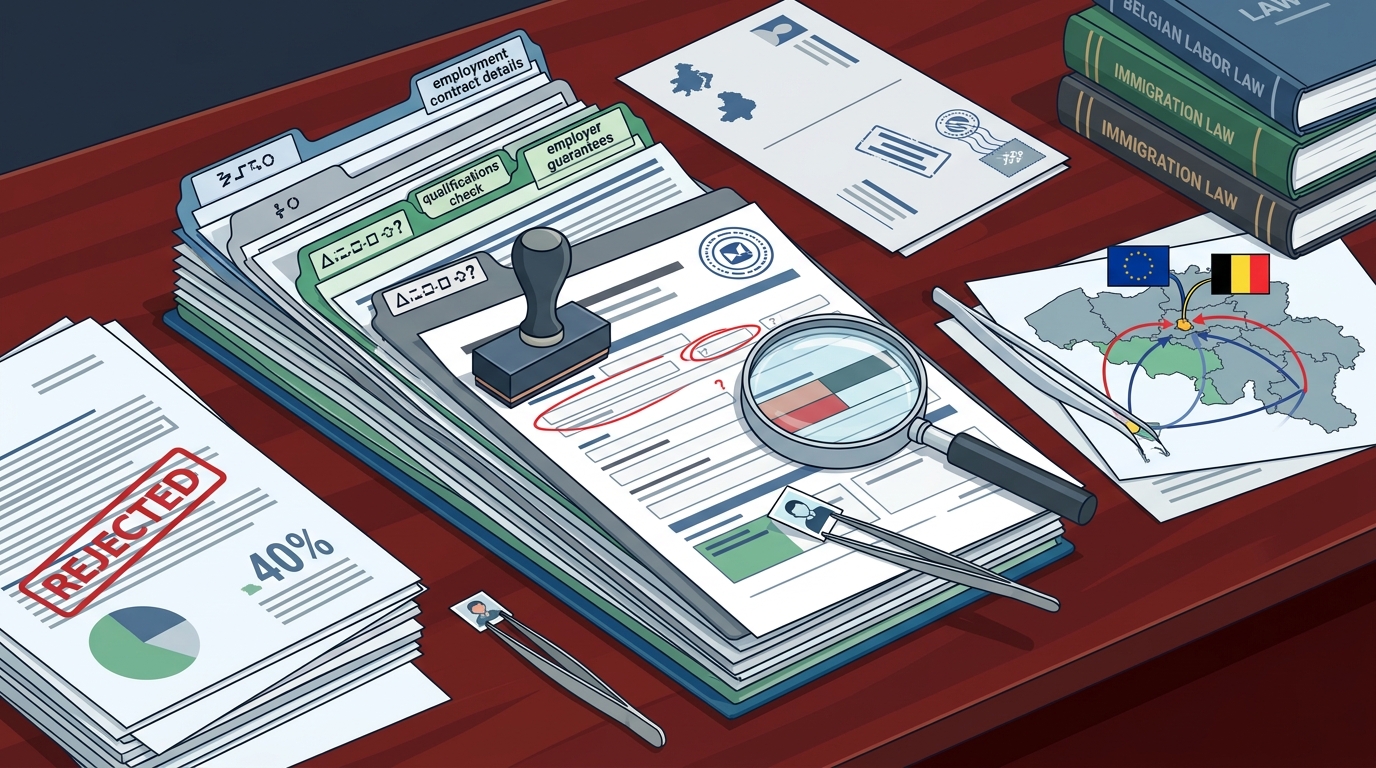
Securing a work permit in Belgium for non-EU citizens is a rigorous process governed by strict federal and regional regulations. According to recent immigration data, nearly 40% of initial applications are delayed or rejected due to procedural errors or incomplete documentation. This high failure rate underscores the necessity of precise legal preparation. Navigating the dual requirements of a work permit and a residence permit requires a deep understanding of Belgian labor law and immigration statutes. This guide outlines the critical errors applicants and employers frequently make and provides actionable strategies to ensure compliance and approval.
Understanding the Permit Types
Before addressing common mistakes, it is essential to define the specific legal instruments involved. Single Permit is a combined authorization that serves as both a work permit and a residence permit for non-EU nationals. This system simplifies the process by consolidating two separate applications into one. Category B Work Permit is a specific type of authorization granted for an indefinite period, typically after the initial probationary period of a Category A permit. Category A Work Permit is a permit granted for an indefinite period, allowing the holder to work for any employer without prior authorization after one year.
Confusion between these categories often leads to incorrect application submissions. For instance, applying for a Category B permit when the role requires the immediate flexibility of a Category A permit can result in unnecessary delays. Employers must accurately assess the job profile and the candidate's status to select the correct permit type. Misclassification is a primary reason for administrative rejection.
Employer Compliance Errors
Employers play a pivotal role in the success of a work permit application. One of the most frequent mistakes is failing to conduct a proper labor market test. In many cases, employers must prove that no suitable EU/EEA candidate was available for the position. This requirement is particularly strict for certain sectors and regions. Maître Nafissatou TINE, an expert in labor law, emphasizes that the employer's justification must be robust and evidence-based.
Another critical error is neglecting the specific requirements for highly skilled migrants. Belgium offers a facilitated procedure for highly skilled non-EU workers, but the criteria are stringent. The salary threshold must be met, and the qualifications must be verified. Failure to meet these thresholds can lead to the application being downgraded or rejected. Additionally, employers often overlook the need for a valid employment contract that complies with Belgian labor standards. Our blog provides further insights into contractual obligations and salary structures.
Contractual Oversights
The employment contract must specify the job title, salary, working hours, and duration. Any discrepancy between the contract and the permit application can cause significant issues. For example, if the contract states a part-time position but the permit is for full-time work, the application will likely be denied. Precision in documentation is non-negotiable.
Documentation Pitfalls
Incomplete or incorrect documentation is the leading cause of application delays. Applicants often submit expired passports, unverified academic diplomas, or insufficient proof of financial means. Proof of Financial Means is a requirement demonstrating that the applicant has sufficient funds to support themselves and their family in Belgium. This proof must be current and meet the minimum income thresholds set by the government.
Another common mistake is failing to provide a clean criminal record extract. The certificate must be recent, usually issued within the last three months, and authenticated if required. For applicants from countries with specific authentication requirements, neglecting the apostille or legalization process can halt the application indefinitely. Legal interim management services can help streamline this process by ensuring all documents are prepared correctly from the outset.
Health Insurance Gaps
Applicants must also demonstrate valid health insurance coverage. While the Belgian public system provides coverage, private insurance is often required during the initial processing period. Failure to provide proof of this coverage can lead to a rejection. It is crucial to align the insurance policy with the duration of the permit application.
Timeline Miscalculations
Timing is a critical factor in work permit applications. The processing time for a single permit can vary significantly depending on the region and the complexity of the case. In Brussels, the application is processed by the Brussels Region authorities, while in Flanders and Wallonia, the respective regional agencies handle the process. Underestimating the processing time can lead to gaps in legal status for the applicant.
Another timeline error is submitting the application too late. Employers must initiate the process well in advance of the intended start date. Delays in document preparation or administrative backlogs can extend the timeline by several months. Proactive planning is essential to avoid disrupting business operations or the applicant's relocation plans.
Renewal Overlooked
Many applicants fail to plan for the renewal of their permits. Work permits are often issued for a limited period, and the renewal process requires a new application. Missing the renewal deadline can result in the loss of legal status and the need to leave the country. Early preparation for renewal is as important as the initial application.
Regional Nuances
Belgium's federal structure means that immigration and labor laws can have regional variations. The requirements and procedures in Brussels may differ slightly from those in Flanders or Wallonia. For example, the specific forms and submission portals vary by region. Ignoring these nuances can lead to administrative errors and delays.
Additionally, certain regions have specific quotas or priorities for non-EU workers. Employers must be aware of these local regulations to ensure their applications are competitive. Contacting a specialized lawyer can help navigate these regional complexities effectively.
Key Takeaways
- Permit Classification: Correctly distinguishing between Category A, Category B, and the Single Permit is crucial for a smooth application process.
- Employer Responsibility: Employers must conduct thorough labor market tests and ensure the job offer meets all legal salary and qualification thresholds.
- Documentation Accuracy: All documents, including criminal records and diplomas, must be current, verified, and properly authenticated.
- Timeline Management: Applications should be submitted well in advance to account for processing times and potential delays.
- Regional Specifics: Understanding the specific requirements of the Brussels, Flanders, or Wallonia regions is essential for compliance.
- Legal Expertise: Engaging a specialized lawyer can prevent costly errors and ensure adherence to complex labor laws.
- Renewal Planning: Early preparation for permit renewals is necessary to maintain continuous legal status.
Frequently Asked Questions
What is the difference between a Category A and Category B work permit?
A Category A work permit is granted for an indefinite period and allows the holder to work for any employer after one year. A Category B work permit is tied to a specific employer and job, and is typically granted for a limited period.
How long does it take to process a single permit in Brussels?
Processing times in Brussels can vary, but they generally take several weeks to a few months. It is advisable to apply well in advance of the intended start date.
Can I apply for a work permit if I am already in Belgium?
In most cases, non-EU nationals must apply for a work permit from outside Belgium. However, there are specific exceptions for certain categories of workers, such as highly skilled migrants.
What documents are required for a single permit application?
Required documents typically include a valid passport, proof of qualifications, a valid employment contract, proof of financial means, and a clean criminal record extract.
Do I need health insurance before applying for a work permit?
Yes, applicants must demonstrate valid health insurance coverage. This can be through the Belgian public system or a private insurance policy that meets the required standards.
What happens if my work permit application is rejected?
If an application is rejected, the applicant may have the right to appeal the decision. It is important to understand the reasons for rejection and address them in a new application or appeal.
How can I ensure my application is processed quickly?
Ensuring all documents are complete, accurate, and submitted correctly is the best way to speed up the process. Working with a legal expert can also help identify and resolve potential issues early.
Secure Your Work Permit with Expert Legal Support
Navigating the complexities of Belgian immigration and labor law requires precision and expertise. Avoid common mistakes and ensure a smooth application process by consulting with a specialized legal professional. Book a consultation today to discuss your specific situation and secure your future in Belgium.