

Expanding your talent pool into the Benelux region is a strategic imperative for many global enterprises, yet the regulatory landscape in Belgium is notoriously complex. According to recent labor market data, over 40% of multinational companies in Europe utilize Employer of Record (EOR) services to bypass the 6-to-12-month setup time required for a local entity. This statistic highlights a critical shift in how global businesses approach international expansion, prioritizing speed and compliance over immediate infrastructure investment. Navigating this terrain requires precise legal knowledge, particularly regarding social security, tax obligations, and employment contracts.
Understanding Belgian Labor Law
Belgium operates under one of the most protective labor frameworks in the European Union. The concept of employer liability is strict, meaning that any entity directing the work of an individual is legally presumed to be their employer. This presumption applies even if the worker is technically employed by a third-party agency or a foreign entity.
For international companies, the definition of an employer is not merely a contractual formality. It is a functional reality determined by who controls the work, sets the hours, and provides the tools. If a foreign company manages a worker in Belgium directly, Belgian authorities may deem that foreign company to have a permanent establishment or a de facto employer presence. This triggers immediate tax and social security liabilities.
Maître Nafissatou TINE, an experienced avocat en droit du travail, emphasizes that the distinction between an independent contractor and an employee is often blurred in cross-border contexts. Belgian law prioritizes the reality of the working relationship over the label chosen in the contract. Misclassification is a primary source of litigation for foreign firms entering the Belgian market.
Legal Structures for Hiring
When entering the Belgian market without a physical branch, companies generally have three primary pathways. Each option carries distinct legal and financial implications.
1. Employer of Record (EOR)
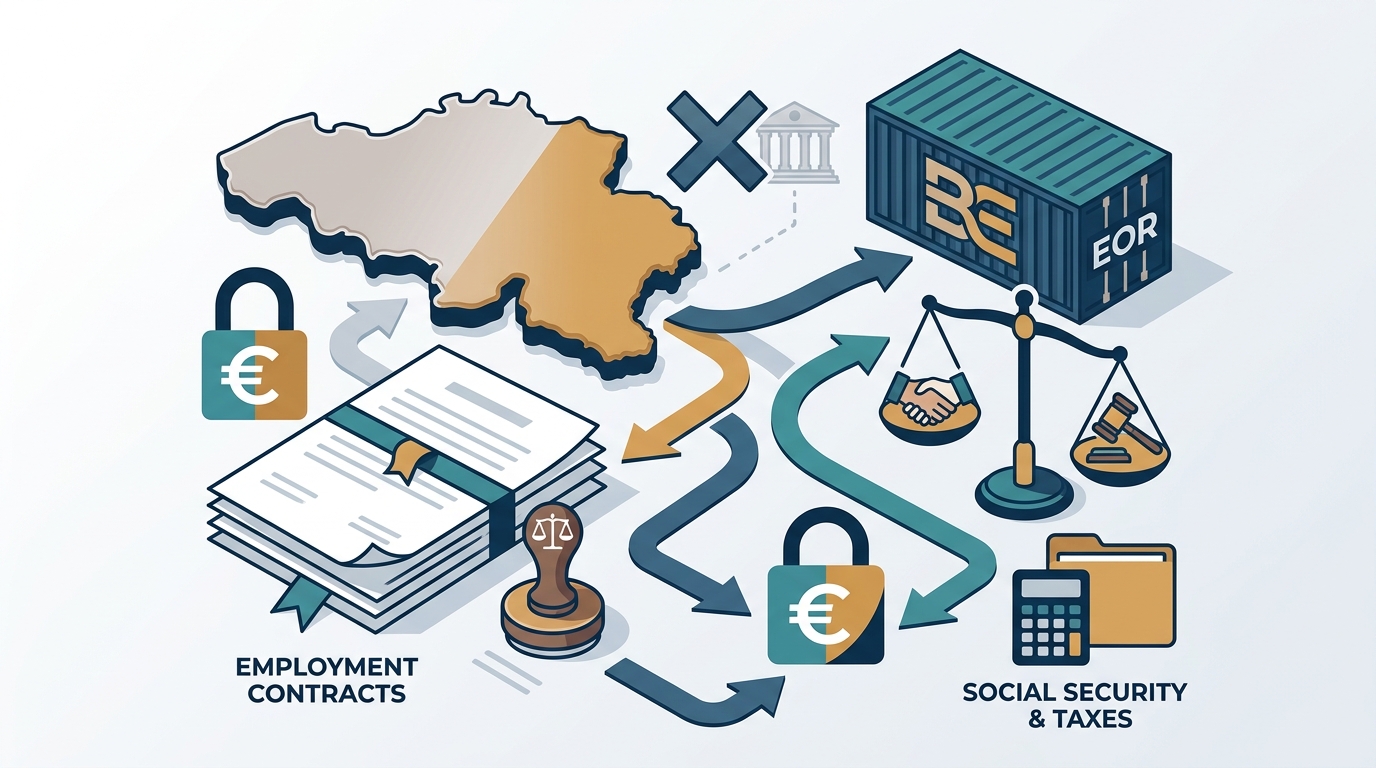
An Employer of Record service acts as the legal employer for your workers in Belgium. The EOR handles all payroll, tax withholdings, and social security contributions. Your company retains full control over the daily work and management of the employee. This model is ideal for testing the market or hiring a small team quickly.
The EOR model ensures compliance with local collective bargaining agreements (CBAs). In Belgium, CBAs set minimum wages and working conditions for specific sectors. Failure to adhere to these agreements can result in significant penalties. The EOR assumes the legal risk of employment, providing a shield for the foreign client.
2. Independent Contractor Model
Some companies attempt to hire workers as independent contractors to avoid employment laws. However, Belgian courts frequently reclassify these relationships as employment contracts if the worker lacks true independence. Factors such as fixed working hours, exclusive service to one client, and integration into the company’s organization signal an employment relationship.
Reclassification leads to back payments of social security, unpaid leave, and severance pay. This approach is high-risk and generally discouraged for long-term hires. For more on managing contractor risks, see our blog insights on contract management.
3. Professional Employer Organization (PEO)
A PEO operates similarly to an EOR but often involves a co-employment relationship. The PEO shares legal responsibility for the employee. This model is less common in Belgium than the EOR model due to the strictness of local labor laws. It is typically used for larger, long-term deployments where the foreign company wants to maintain a closer legal tie to the workforce.
Social Security Compliance
Social security is the most complex aspect of hiring in Belgium. The system is managed by the ONSS (Office National de Sécurité Sociale). Foreign employers must determine whether their workers are subject to Belgian social security or remain covered by their home country’s system.
The 90-Day Rule
Under EU regulations, a worker posted to Belgium for less than 90 days may remain covered by their home country’s social security system. This requires obtaining an A1 form from the home country’s authority. The A1 form proves that social security is paid elsewhere, exempting the worker from Belgian contributions.
However, if the assignment exceeds 90 days, or if the worker is hired directly into Belgium, they must be registered with the Belgian social security system. The employer must pay both the employer and employee portions of social security contributions. These contributions are high, often exceeding 25% of the gross salary for the employer.
Health Insurance and Benefits
Belgian employees are entitled to comprehensive health insurance through mutualities. Employers must contribute to these mutualities. Additionally, employees accrue paid leave, which is calculated based on actual days worked. The accrual rate is precise and strictly enforced. Missing a single day of leave calculation can lead to disputes.
For detailed advice on protection sociale and social security claims, consult with a specialized legal professional.
Tax Implications for Employers
Tax compliance in Belgium involves both income tax withholding and corporate tax considerations. Foreign employers must register for a Belgian tax number to withhold and remit employee income tax. This process is automated through the EOR model, where the EOR acts as the withholding agent.
Permanent Establishment Risk
If a foreign company hires employees in Belgium, it may create a Permanent Establishment (PE). A PE is a fixed place of business through which the company carries out its business activities. If a PE is established, the foreign company may be subject to Belgian corporate income tax on the profits attributable to that PE.
The threshold for creating a PE can be low. Having an employee who has the authority to conclude contracts in Belgium can trigger PE status. This is a critical risk for sales and business development teams. Proper structuring is essential to mitigate this risk.
Withholding Tax on Services
If you hire independent contractors, you may be required to withhold tax on their invoices. The rate varies depending on the contractor’s status and the nature of the services. Failure to withhold can make the client liable for the tax amount. This is a common pitfall for foreign companies unfamiliar with Belgian fiscal code.
Risk Management and Mitigation
Hiring in Belgium without a local office requires proactive risk management. The legal environment is litigious, and employees have strong rights. Ignorance of local laws is not a defense in Belgian courts.
Contractual Clarity
Employment contracts must be in French or Dutch, the official languages of the region. English-only contracts are often deemed invalid or unenforceable in labor disputes. The contract must include specific mandatory clauses, such as working hours, salary details, and notice periods.
Notice periods are long in Belgium. For blue-collar workers, they are calculated based on seniority. For white-collar workers, they are fixed by law and can range from several months to over a year. Severance pay is also calculated based on seniority and salary, adding significant cost to termination.
Data Privacy (GDPR)
Belgium has strict data privacy laws aligned with the GDPR. Employers must register their processing activities with the Belgian Data Protection Authority. Employee data must be processed lawfully, fairly, and transparently. Failure to comply can result in heavy fines.
Maître Tine provides RGPD compliance services to help companies navigate these requirements. Proper data governance is part of a robust hiring strategy.
Key Takeaways
- Strict Employer Definition: Belgian law presumes the entity controlling the work is the employer, regardless of contractual labels.
- Social Security Complexity: The 90-day rule for posted workers is a critical threshold for social security exemption via the A1 form.
- High Compliance Costs: Social security contributions and mandatory benefits significantly increase the cost of employment beyond base salary.
- Language Requirements: Employment contracts must be in French or Dutch to be legally valid and enforceable.
- Notice Periods: Long statutory notice periods and severance pay make termination costly and complex.
- PE Risk: Hiring employees can create a Permanent Establishment, triggering corporate tax liabilities in Belgium.
- EOR Advantage: Using an Employer of Record mitigates legal risk and accelerates time-to-hire by handling local compliance.
Frequently Asked Questions
Can I hire employees in Belgium without registering a company?
Yes, you can hire employees in Belgium without a local entity by using an Employer of Record (EOR). The EOR acts as the legal employer, handling all compliance, payroll, and tax obligations. This allows you to manage the worker directly while remaining compliant with Belgian labor laws.
What is the A1 form and when is it required?
The A1 form is a certificate that proves an employee remains covered by their home country’s social security system while working temporarily in Belgium. It is required for posted workers staying in Belgium for less than 90 days. For longer stays, Belgian social security applies.
Do employment contracts need to be in a specific language?
Yes, employment contracts in Belgium must be written in French or Dutch. English contracts are generally not accepted as valid legal documents in labor disputes. Bilingual contracts are often recommended for international teams.
How long are the notice periods for termination?
Notice periods in Belgium are among the longest in Europe. For white-collar employees, the notice period is fixed by law and depends on the industry and seniority. It can range from 3 months to over 10 months. Blue-collar workers have notice periods calculated based on their years of service.
What are the risks of misclassifying workers as contractors?
Misclassification can lead to reclassification by Belgian courts as an employment relationship. This results in back payments of social security, unpaid leave, and severance pay. It can also trigger tax liabilities and penalties for the foreign company.
Is Belgium considered a high-cost employment market?
Yes, Belgium has high labor costs due to substantial social security contributions, mandatory benefits, and high taxes. The total cost of employment is often 30-40% higher than the gross salary. However, the workforce is highly skilled and multilingual.
How does GDPR apply to hiring in Belgium?
Belgium enforces strict GDPR rules for employee data. Employers must register their data processing activities with the Belgian Data Protection Authority. Data must be processed lawfully, and employees must be informed about how their data is used. Non-compliance can lead to significant fines.
Contact Our Experts
Navigating the complexities of Belgian labor law requires expert guidance. Whether you are considering an EOR model, need help with social security registration, or require contract review, our team is here to assist. We provide tailored legal solutions for international businesses expanding into Belgium.
For personalized advice on hiring in Belgium, schedule a consultation with Maître Nafissatou TINE. We help you mitigate risk and ensure compliance from day one.