

Hiring foreign employees in Belgium involves navigating a complex web of labor laws, social security regulations, and immigration requirements. According to recent data from the Federal Public Service Employment, roughly 15% of the Belgian workforce consists of foreign nationals, highlighting the critical need for precise legal compliance in cross-border hiring. A multilingual labor lawyer in Belgium who speaks French, Dutch, and English is essential to ensure that your employment contracts, social security declarations, and immigration permits are fully aligned with local statutes. This guide outlines the specific legal obligations, the role of specialized counsel, and the strategic advantages of engaging expert legal support for international recruitment. (Contact Avocat en droit)
Why a Multilingual Lawyer is Critical
Belgium is a tri-lingual country with French, Dutch, and German as official languages. In the Brussels-Capital Region, both French and Dutch are used in administrative and legal proceedings. When hiring foreign employees, the language of the employment contract and internal company policies must often comply with local linguistic laws. A lawyer fluent in French, Dutch, and English can bridge the gap between international talent and local regulatory demands.
Without multilingual legal support, companies risk non-compliance with the Law of 15 June 1935 on the protection of the French language in legislation and official relations, or its Dutch equivalent. This law mandates that employment contracts and internal regulations be drafted in the language of the region where the work is performed. For international companies, this creates a significant barrier if their HR teams do not speak the local language. A specialized attorney ensures that all documentation is legally valid and culturally appropriate.
Furthermore, communication with local authorities such as the ONSS (National Office for Social Security) and the FPS Employment requires precise terminology. Misinterpretation of legal terms can lead to severe penalties, back payments of social security contributions, and even criminal liability for company directors. Engaging a lawyer like Maître Nafissatou Tine, who specializes in labor law and social security, provides a strategic advantage in navigating these complexities.
The Belgian Legal Framework for Foreign Hires
Belgian labor law is highly protective of employees, regardless of their nationality. The core principle is that the employment relationship is governed by Belgian law if the work is performed in Belgium. This includes minimum wage requirements, maximum working hours, and mandatory leave entitlements.
One critical aspect is the distinction between independent contractors and employees. Misclassification is a common pitfall for foreign hires. If a foreign expert is hired as a contractor but works under the direction of the Belgian company, they may be reclassified as an employee by labor inspectors. This reclassification triggers immediate social security liabilities and back taxes. A multilingual lawyer can conduct a thorough audit of the working relationship to ensure proper classification.
Additionally, collective bargaining agreements (CBAs) play a significant role in Belgian labor law. These agreements, negotiated between employer organizations and trade unions, often set specific rules for wages, bonuses, and working conditions. Foreign employees are generally entitled to the same benefits as Belgian nationals under these CBAs. Understanding these nuances is vital for competitive and compliant compensation packages.
Immigration Permits and Work Visas
For non-EU/EEA/Swiss nationals, hiring in Belgium requires securing a work permit and a residence permit. The process is rigorous and time-sensitive. The employer must first obtain a single permit (combined work and residence permit) from the regional immigration office.
The type of permit depends on the employee's profile. For highly skilled workers, the EU Blue Card offers a streamlined process with faster residency rights. For other professionals, the Temporary Work Permit or Seasonal Work Permit may be applicable. Each category has specific salary thresholds and labor market test requirements, where the employer must prove that no suitable EU candidate was available for the role.
A multilingual lawyer assists in preparing the necessary documentation, including proof of qualifications, salary slips, and job descriptions that meet Belgian standards. They also handle communications with the Office des Étrangers (Office for Foreigners) and ensure that the employment contract aligns with the conditions of the work permit. Failure to secure the correct permit before the employee starts working can result in heavy fines and deportation orders.
Social Security and Tax Implications
Belgium has one of the highest social security contribution rates in the world. Employers must register with the ONSS and pay contributions based on the employee's gross salary. For foreign hires, it is crucial to determine whether they are subject to Belgian social security or if an exemption applies under bilateral social security agreements.
Many countries have bilateral agreements with Belgium that prevent double social security taxation. For example, citizens from certain countries may remain covered by their home country's social security system for a limited period (usually up to 24 months) if they provide a Certificate of Coverage. A multilingual lawyer can advise on these exemptions and ensure that the correct forms are submitted to avoid double contributions.
Taxation is another complex area. Foreign employees may be subject to Belgian income tax on their Belgian-sourced income. Depending on their residency status and the length of their stay, they may qualify for the 15% tax exemption for expatriates (the expat tax regime), which significantly reduces their taxable income. This regime is highly regulated and requires specific application procedures. Legal counsel is essential to determine eligibility and ensure compliance with the strict conditions of this tax benefit.
Drafting Compliant Employment Contracts
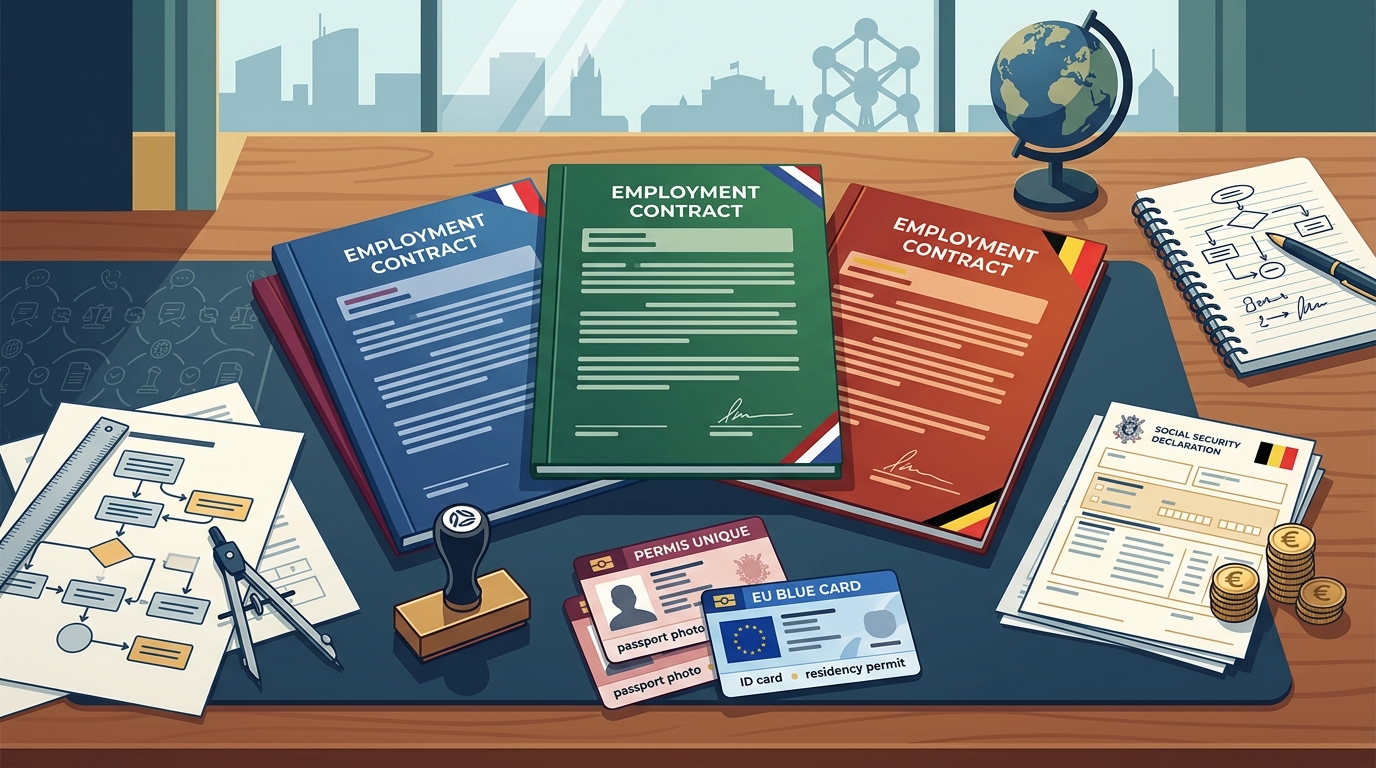
The employment contract is the foundation of the legal relationship. In Belgium, a written contract is mandatory for all employees, regardless of the duration of the employment. The contract must include specific clauses required by law, such as the job title, salary, working hours, and notice periods.
For foreign hires, the contract must also address cross-border issues. These include:
- Language of the Contract: As mentioned, the contract must be in the language of the region where the work is performed. A bilingual version may be provided for the employee's understanding, but the legal version must comply with local law.
- Governing Law: The contract must explicitly state that Belgian law governs the employment relationship.
- Probation Period: The length of the probation period is strictly regulated by CBA and industry. Exceeding the legal limit can render the probation clause null and void.
- Confidentiality and Non-Compete Clauses: These must be drafted carefully to be enforceable in Belgium. Non-compete clauses, in particular, require financial compensation to the employee during the restriction period.
A multilingual lawyer ensures that these clauses are tailored to the specific role and industry, providing maximum protection for the employer while remaining legally enforceable. They also advise on the integration of the employee into the company culture and the management of any potential disputes.
Key Takeaways
- Linguistic Compliance: Employment contracts in Belgium must be in the language of the region (French or Dutch) to be legally valid.
- Immigration Complexity: Non-EU hires require a single work and residence permit, with specific categories like the EU Blue Card for highly skilled workers.
- Social Security: Employers must register with the ONSS and check for bilateral agreements to avoid double taxation.
- Tax Benefits: The 15% expat tax regime can significantly reduce tax liabilities for qualifying foreign employees.
- Multilingual Legal Support: A lawyer fluent in French, Dutch, and English is essential for navigating the tri-lingual legal landscape and communicating with authorities.
- Contractual Precision: Belgian labor law is highly protective; contracts must include mandatory clauses and adhere to strict probation and notice period rules.
- Proactive Strategy: Engaging legal counsel early in the hiring process prevents costly compliance errors and ensures a smooth onboarding experience.
Frequently Asked Questions
Do I need a lawyer who speaks French and Dutch to hire in Belgium?
Yes, because Belgian labor law and administrative procedures are conducted in the local language of the region. A multilingual lawyer ensures that all documents and communications are legally accurate and compliant.
Can a foreign employee work in Belgium without a work permit?
No, non-EU/EEA/Swiss nationals must obtain a work permit before starting work. Working without a permit is illegal and can result in fines for both the employee and the employer.
What is the EU Blue Card and who is eligible?
The EU Blue Card is a residence permit for highly skilled non-EU workers. It requires a university degree and a job offer with a salary above a certain threshold. It offers faster access to permanent residency.
How does the 15% expat tax regime work?
This regime allows qualifying expatriates to deduct 15% of their gross Belgian salary from their taxable income, effectively reducing their tax burden. It is subject to strict eligibility criteria and time limits.
What happens if an employment contract is not in the local language?
The contract may be deemed invalid or unenforceable in labor disputes. Additionally, the employer may face administrative fines for violating linguistic laws.
Do I need to pay social security for foreign employees?
Generally, yes. However, bilateral social security agreements may allow employees to remain covered by their home country's system for a limited period. A lawyer can help determine eligibility for exemptions.
How long does the work permit process take?
The processing time varies by region and permit type, but it typically takes several weeks to months. Early application is crucial to avoid delays in starting the job.
Can a multilingual lawyer help with visa extensions?
Yes, a specialized labor lawyer can assist with renewing work permits and residence permits, ensuring that the employee's status remains legal and compliant with changing regulations.
Contact Our Legal Team
Navigating the complexities of hiring foreign employees in Belgium requires expert legal guidance. Whether you need assistance with immigration permits, social security compliance, or drafting multilingual employment contracts, our team is here to help. We provide comprehensive legal services tailored to the needs of international businesses and foreign workers.
For personalized advice and support, please schedule a consultation with our labor law experts. We are committed to ensuring your hiring process is smooth, compliant, and successful.