

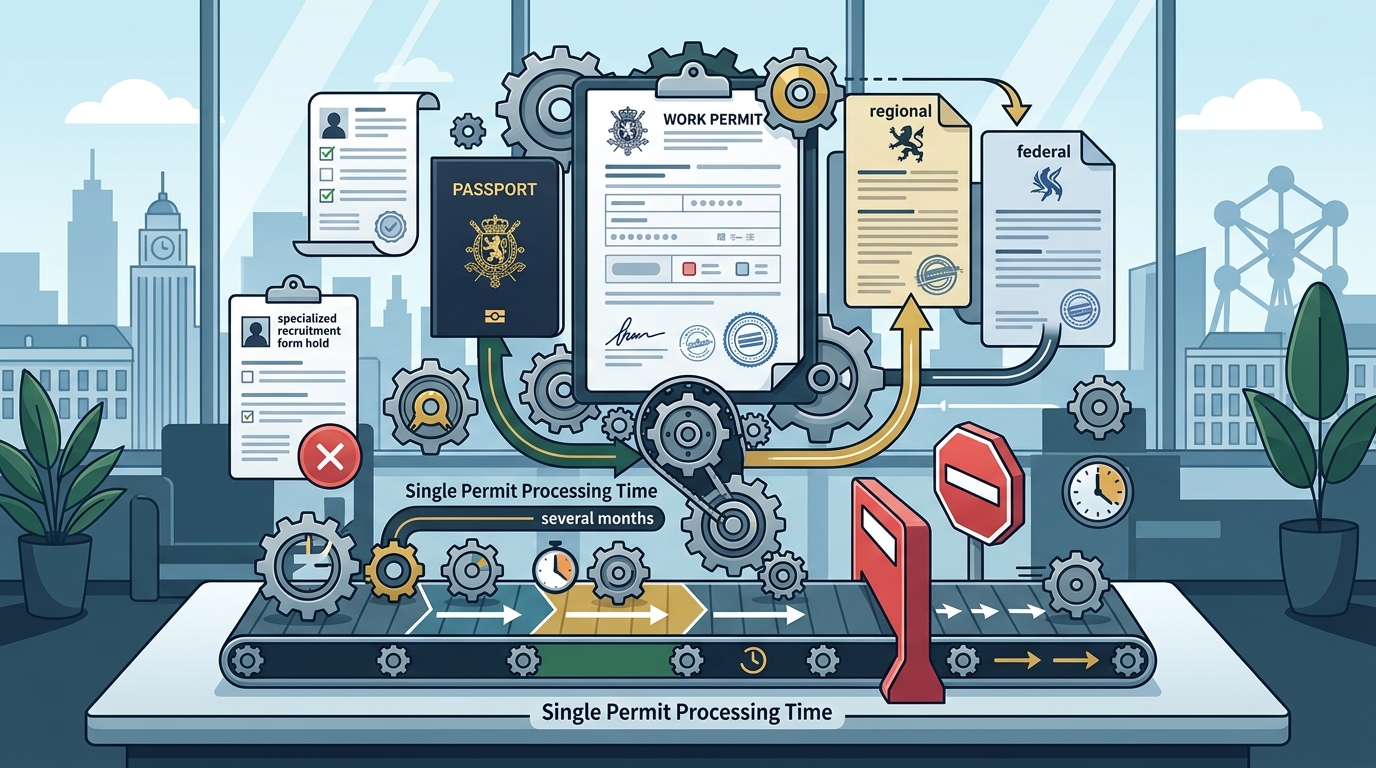
Securing the right to work in Belgium for non-EU citizens is a rigorous process governed by strict federal and regional regulations. According to recent immigration data, the processing time for single permits can vary significantly depending on the region, often taking several months to finalize. This delay creates immediate operational challenges for companies seeking to fill specialized roles. Navigating this landscape requires precise legal intervention to avoid compliance penalties and recruitment delays.
Understanding the Legal Framework
Belgium operates under a decentralized system for immigration and labor. The Single Permit is the primary document required for non-EU nationals to work and reside in the country simultaneously. This permit combines the authorization to stay (residence) with the authorization to work (employment). Without this dual authorization, hiring a non-EU employee is illegal and subject to severe sanctions. (Avocat en droit du)
The process is not uniform across the entire country. It is divided into two main regional authorities. In Flanders, the agency is the VDAB (Vlaamse Dienst voor Arbeidsovereenkomsten). In Wallonia and Brussels, the responsibility lies with the FOREM or VDAB equivalents depending on the specific municipal regulations. Understanding this geographic split is the first step in any successful application. (Avocat en droit du)
Legal interim management and strategic consulting are often necessary during this phase. Companies must demonstrate that no suitable candidate from the EU/EEA labor market is available for the role. This is known as the labor market test. Our team at Tine Avocat specializes in preparing the necessary documentation to prove this necessity effectively.
The Single Permit Process
The application for a single permit is initiated by the employer, not the employee. This places the burden of proof and procedural compliance squarely on the company. The process involves several critical stages that require meticulous attention to detail.
Step 1: The Labor Market Test
Before applying for the permit, the employer must prove that the position could not be filled by an EU citizen. This involves advertising the role for a specific period, typically 10 to 14 days, in designated channels. The advertisement must meet specific criteria regarding salary and qualifications. Failure to adhere to these advertising standards can result in an automatic rejection of the permit application.
Step 2: Submission of the Application
Once the labor market test is complete, the employer submits the single permit application to the regional employment agency. This submission includes the employment contract, proof of the candidate's qualifications, and evidence of the labor market test results. The application must be filed before the candidate enters Belgium, unless they are already legally present with a valid long-stay visa.
Step 3: Review and Decision
The regional agency reviews the application for completeness and compliance. They may request additional information or clarification. Once approved, the permit is sent to the municipal administration of the employer's location. The employee then uses this permit to apply for a long-stay visa at the Belgian consulate in their home country.
Regional Differences: Flanders vs. Wallonia
The procedural nuances between regions can significantly impact the timeline and success rate of a work permit application. Employers must tailor their strategy based on the location of the business.
| Feature | Flanders (VDAB) | Wallonia/Brussels (FOREM/VDAB) |
|---|---|---|
| Primary Agency | VDAB | FOREM or local municipal body |
| Processing Time | Generally faster, approx. 30-45 days | Variable, often longer due to backlog |
| Salary Thresholds | Strict sector-specific scales | Similar scales but different enforcement |
| Language Requirements | Dutch may be required for integration | French or Dutch depending on region |
These differences mean that a one-size-fits-all approach to immigration compliance is ineffective. Employers must engage legal counsel who understands the specific administrative culture of the region where the company is headquartered. For companies operating in both regions, a coordinated legal strategy is essential to ensure consistency and efficiency.
Employer Obligations and Compliance
Compliance with Belgian labor law extends beyond the initial permit application. Employers must maintain rigorous records and adhere to ongoing reporting requirements. Non-compliance can lead to heavy fines, blacklisting from future permit applications, and legal action against the company directors.
Contractual Requirements
The employment contract submitted with the permit application must meet specific legal standards. It must include clauses regarding salary, working hours, and notice periods that comply with Belgian law. The salary must also meet the minimum threshold for highly skilled migrants or the sector-specific minimum wage. Any deviation from these standards can result in the permit being denied.
Ongoing Reporting
Once the employee is hired, the employer must report the start of employment to the relevant social security agencies, such as the ONSS (Office National de Sécurité Sociale). Failure to report this information can lead to penalties for both the employer and the employee. Additionally, any changes to the employment contract, such as a change in salary or job title, must be reported to the authorities.
We assist our clients in drafting compliant employment contracts and managing ongoing social security obligations. Our expertise in social security and social protection ensures that your company remains compliant throughout the employment lifecycle.
Choosing the Right Legal Expert
Not all legal professionals are equipped to handle the complexities of Belgian immigration and labor law. You need an expert who understands both the legal framework and the practical realities of the labor market. Look for a firm that offers comprehensive services, including contract drafting, litigation support, and strategic consulting.
At Tine Avocat, we specialize in employment law in Brussels and Anderlecht. Our team provides tailored solutions for both companies and workers. We help you navigate the complexities of the single permit process, ensuring that your applications are submitted correctly and on time. Our services include:
- Drafting and analyzing employment contracts.
- Preparing for labor market tests.
- Representing employers in litigation related to work permits.
- Advising on social security and protection issues.
Our approach is characterized by reactivity and transparent communication. We understand that time is critical in recruitment, and we work efficiently to resolve legal hurdles quickly.
Key Takeaways
- The Single Permit is required for non-EU nationals to work and reside in Belgium.
- The application process is managed by regional authorities: VDAB in Flanders and FOREM in Wallonia/Brussels.
- Employers must conduct a labor market test to prove no EU candidate is available.
- Compliance with social security regulations is mandatory and ongoing.
- Regional differences in processing times and requirements require localized legal strategies.
- Incorrect contract drafting can lead to permit rejection and legal penalties.
- Specialized legal counsel is essential for navigating complex immigration laws.
Frequently Asked Questions
Who can apply for a work permit in Belgium?
The employer must apply for the work permit on behalf of the non-EU employee. The employee cannot apply independently without an employer sponsor.
How long does the single permit process take?
Processing times vary by region. In Flanders, it typically takes around 30 to 45 days. In Wallonia and Brussels, it can take longer due to administrative backlogs.
What is the labor market test?
The labor market test requires the employer to advertise the job vacancy to the local labor market for a specific period to prove that no EU/EEA candidate is available for the role.
Can a non-EU employee work in Belgium without a permit?
No. Working without a valid single permit or work authorization is illegal and can result in severe penalties for both the employer and the employee.
What happens if the permit application is rejected?
If rejected, the employer can appeal the decision within a specific timeframe. It is crucial to understand the reasons for rejection to address them in a new application.
Do I need a lawyer for the application?
While not legally mandatory, hiring a specialized employment lawyer is highly recommended to ensure compliance and avoid costly errors.
What is the role of the ONSS?
The ONSS (National Office for Social Security) collects social security contributions from employers. Employers must report the employee's start date to the ONSS.
Contact Our Employment Law Team
Navigating Belgian work permit regulations requires precision and expertise. Do not leave your recruitment strategy to chance. Contact Tine Avocat today to schedule a consultation and ensure your company remains compliant and competitive.
Book a Consultation with our team of experts in Brussels and Anderlecht.