

Employing foreign talent in Belgium offers significant strategic advantages, yet it introduces complex regulatory layers that demand precise legal navigation. According to recent labor market analyses, the Belgian economy relies heavily on international expertise to fill critical skill gaps, particularly in technology and engineering sectors. However, the administrative burden of cross-border employment can stall growth if not managed correctly. This guide outlines how specialized legal counsel ensures compliance with Belgian labor laws, social security regulations, and tax obligations for both employers and international employees.
Why Multilingual Legal Counsel is Critical
Belgium is a multilingual country with three official languages: Dutch, French, and German. The language of the employment contract is strictly regulated by the region where the employee works. In Brussels, both French and Dutch are official, meaning contracts must often be bilingual or chosen based on the employee's preference. A lawyer who speaks French, Dutch, and English is not just a convenience but a legal necessity for ensuring that foreign employees fully understand their rights and obligations.
Without precise translation and legal interpretation, companies risk invalidating contracts or facing penalties for non-compliance. Maître Nafissatou TINE provides expertise in this exact intersection, offering services that bridge the gap between international business needs and local Belgian legal requirements. Her practice covers the entire lifecycle of employment, from initial contract drafting to dispute resolution.
For employers, the ability to communicate in the employee's native language reduces the risk of misunderstandings regarding working conditions, remuneration, and termination clauses. This clarity is essential for maintaining a positive employer brand and ensuring smooth integration of international staff into the Belgian workforce.
The Belgian Labor Law Framework
Belgian labor law is known for its high level of protection for employees. It is one of the most rigid labor markets in Europe, which means that hiring foreign employees requires strict adherence to statutory rules. The law dictates specific procedures for hiring, working hours, leave entitlements, and termination.
One of the most critical aspects is the work permit requirement. For non-EU/EEA/Swiss nationals, the employer must typically apply for a single permit (combined work and residence permit) before the employee starts working. This process involves proving that no suitable candidate could be found within the EU/EEA/Switzerland for the role. A specialized lawyer ensures that the job description and recruitment process are documented correctly to withstand scrutiny from the Federal Public Service Employment.
Additionally, the collective bargaining agreements (CBAs) in Belgium set minimum standards for wages, bonuses, and benefits. These agreements vary by sector and region. A multilingual lawyer can interpret these complex documents and ensure that the employment contract offers terms that are at least as favorable as the applicable CBA. Failure to comply can result in significant back-pay liabilities and legal sanctions.
Social Security and Tax Implications
Managing social security contributions is a major challenge for companies hiring foreign workers. Belgium has an extensive social security system that covers health insurance, pensions, and unemployment benefits. The general rule is that employees working in Belgium are subject to Belgian social security contributions, regardless of their nationality or residence.
However, there are exceptions for short-term postings. If an employee is posted to Belgium for less than 24 months, they may remain covered by their home country's social security system under certain conditions. This requires obtaining a Form A1 certificate from the home country's social security institution. A lawyer specializing in social security law can help determine eligibility and manage the application process to avoid double contributions.
Tax residency is another key factor. An individual becomes a tax resident in Belgium if they live there for more than 183 days in a calendar year or if their center of vital interests is in Belgium. Foreign employees may benefit from specific tax regimes, such as the expatriate tax ruling, which can exempt a portion of their salary from Belgian taxation. Eligibility for this regime depends on the employee's expertise and the nature of the role. Legal counsel can assess whether the company qualifies for this benefit and guide the employee through the application process.
Drafting Compliant Employment Contracts
The employment contract is the foundation of the employer-employee relationship in Belgium. It must be in writing and contain specific mandatory clauses as required by law. These include details on remuneration, working hours, leave entitlements, and the applicable collective bargaining agreement.
For foreign employees, the contract must also address the language of the contract. In Brussels, the contract can be in French, Dutch, or another language, but it must be provided in a language the employee understands. A multilingual lawyer ensures that the translation is legally accurate and that the employee acknowledges receipt of the contract in their preferred language.
Key clauses to include in the contract for foreign hires are:
- Probationary Period: Typically one month for blue-collar workers and two months for white-collar workers, with the possibility of extension under specific conditions.
- Notice Period: Strict statutory notice periods apply for termination, which vary based on the employee's salary and length of service.
- Confidentiality and Non-Compete: These clauses must be drafted carefully to be enforceable. Non-compete clauses require compensation to the employee during the restriction period.
- Expatriation Benefits: Details on relocation assistance, housing allowances, and tax equalization policies.
Maître TINE offers specialized legal interim management services to assist companies in drafting and reviewing these contracts. Her approach ensures that the contract is not only compliant but also tailored to the specific needs of the international hire and the company.
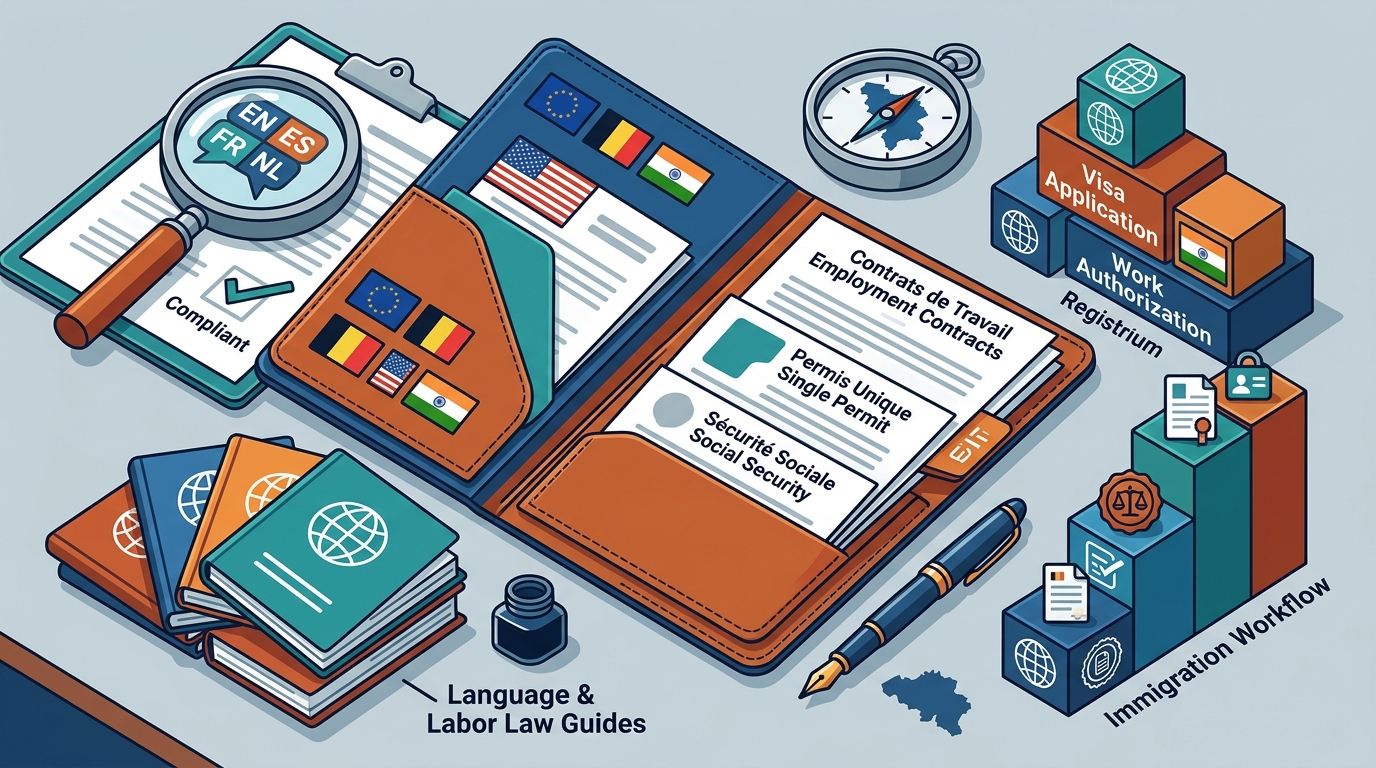
Service Comparison: General vs. Specialized Counsel
Choosing the right legal partner is crucial for successful international hiring. Below is a comparison of the benefits of working with a specialized multilingual labor lawyer versus a generalist.
| Feature | Specialized Multilingual Labor Lawyer | Generalist Lawyer |
|---|---|---|
| Language Proficiency | Fluent in French, Dutch, and English | May lack fluency in all three official languages |
| Knowledge of Social Security | Deep expertise in Form A1 and cross-border rules | Basic understanding, may miss nuances |
| Tax Ruling Assistance | Can guide through expatriate tax regimes | Usually refers to tax specialists |
| Contract Drafting | Bilingual contracts compliant with regional laws | May not ensure accurate translation |
| Work Permit Support | Assists with single permit applications | Limited experience with immigration procedures |
As highlighted in recent updates on labor law changes and their impacts, the regulatory landscape is constantly evolving. A specialized lawyer stays current with these changes, ensuring that your hiring practices remain compliant. For more insights on optimizing salaries and benefits, you can read about strategies to boost employee salaries within legal frameworks.
Key Takeaways
- Belgium requires strict adherence to regional language laws for employment contracts, making multilingual legal counsel essential.
- Non-EU foreign employees typically need a single work and residence permit, which requires employer sponsorship.
- Social security contributions are generally due in Belgium, but Form A1 can exempt short-term posted workers.
- Expatriate tax rulings can significantly reduce the tax burden for highly skilled foreign hires.
- Employment contracts must include mandatory clauses and comply with sector-specific collective bargaining agreements.
- Maître Nafissatou TINE offers 13 years of experience in labor law and social security, providing tailored solutions for international employers.
- Legal interim management services are available for companies needing strategic legal support for specific hiring projects.
Frequently Asked Questions
Do I need a lawyer who speaks Dutch and French to hire in Belgium?
Yes, because Belgian labor law mandates that the employment contract be in a language the employee understands. In Brussels, this often means providing the contract in both French and Dutch, or in a third language if agreed upon. A multilingual lawyer ensures legal accuracy in all languages.
Can foreign employees work in Belgium without a work permit?
EU/EEA/Swiss citizens do not need a work permit. However, non-EU/EEA/Swiss nationals generally require a single permit (work and residence) before starting their job. The employer must apply for this permit.
What is the Form A1 certificate?
The Form A1 certificate proves that an employee remains subject to the social security legislation of their home country while working temporarily in Belgium. It prevents double social security contributions for posted workers.
How long does the work permit application process take?
The processing time for a single permit can vary but typically takes several weeks to months. It is advisable to start the process well in advance of the intended start date to avoid delays.
Are there tax benefits for expatriates in Belgium?
Yes, Belgium offers an expatriate tax ruling that can exempt up to 70% of an expatriate's salary from Belgian taxation for a period of up to 10 years. Eligibility depends on the employee's expertise and the role.
What happens if an employment contract is not in the correct language?
An employment contract not in the correct language may be deemed invalid or unenforceable. It can also lead to administrative fines and disputes regarding the terms of employment.
Does Maître TINE offer services for independent contractors?
Yes, Maître TINE assists both employees and independent contractors. She provides advice on freelance contracts, expatriation agreements, and the legal distinctions between employment and self-employment in Belgium.
Contact for Legal Consultation
Navigating the complexities of Belgian labor law as an international employer requires expert guidance. Whether you are hiring your first foreign employee or managing a global team, specialized legal counsel can protect your business and ensure compliance. Book a consultation with Maître Nafissatou TINE to discuss your specific hiring needs. For more information on her practice, visit the Avocat en Droit du Travail page. You can also explore her blog for the latest updates on labor law and employment strategies.