

Expanding your US business into the European market is a strategic milestone, but Belgium presents one of the most structured and regulated employment landscapes in the EU. According to recent labor market data, over 60% of multinational companies encounter significant compliance delays when entering the Belgian market due to unfamiliarity with local social security and work permit laws. Navigating these regulations is not merely a bureaucratic hurdle; it is a critical component of your operational integrity. This guide details the precise legal pathways available to American enterprises, ensuring you avoid severe penalties while building a robust local team.
Understanding Legal Structures for Foreign Employers
Before you can issue an offer letter, you must establish a legal presence or a compliant mechanism to employ staff in Belgium. The Belgian legal system does not allow a foreign entity to directly sign an employment contract with an individual located in Belgium without a local legal footprint. This is a fundamental rule of Belgian labor law.
There are two primary methods to achieve this. The first is establishing a Belgian subsidiary, such as a BV (Besloten Vennootschap), which is the local equivalent of an LLC. This entity becomes the legal employer, responsible for all local taxes, social security contributions, and labor law compliance. The second method is using a Professional Employer Organization (PEO) or an Employer of Record (EOR). These services act as the legal employer on your behalf, handling payroll and compliance while you manage the daily work. For companies seeking immediate operational flexibility without the heavy setup costs of a subsidiary, legal interim management offers a robust alternative for temporary or project-based hiring needs.
Work Permits and Visas for Non-EU Talent
If you intend to hire talent from outside the European Union, the process becomes significantly more complex. Belgium has strict quotas and labor market tests to protect local employment. The single permit (single permit) is the unified document that combines both the authorization to work and the residence visa for non-EU nationals.
The employer must typically prove that no suitable candidate was available within the EU/EEA before sponsoring a non-EU worker. This process involves rigorous documentation and often requires a waiting period of several months. Ms Tine, a lawyer specializing in employment law and social security, has advised numerous companies on navigating these international mobility and work permit challenges for over 13 years. Her expertise ensures that applications are submitted with the precision required by Belgian immigration authorities, minimizing the risk of rejection.
Social Security and Tax Compliance
Belgium is known for its high social security contributions and complex tax regime. When you hire locally, you are not just paying a salary; you are managing a significant overhead of social costs. The employer's social security contributions can range from 25% to 35% of the gross salary, depending on the sector and specific exemptions.
Compliance with the rules on secondment in Belgium is also critical if you are sending employees from the US or another EU country temporarily. Failure to register correctly can lead to double taxation and heavy penalties. Furthermore, compliance with legal obligations extends to data protection. You must ensure that employee data is handled in accordance with the General Data Protection Regulation (GDPR), which is strictly enforced in Belgium. Our firm provides comprehensive RGPD compliance, audit, advice and training to ensure your HR practices meet these stringent European standards.
Employment Contract Requirements
Belgian employment law is highly protective of employees, and contracts must reflect this balance. Unlike the US "at-will" employment model, Belgian contracts are governed by collective bargaining agreements (CBAs) that dictate minimum wages, working hours, and termination procedures.
Key elements of a compliant Belgian employment contract include:
- Probation Period: Typically 14 to 30 days for blue-collar workers and up to 6 months for white-collar workers, depending on the CBA.
- Working Hours: Standard full-time is 38 hours per week, with strict limits on overtime.
- Remuneration Policy: Includes base salary, bonuses, benefits in kind, and profit-sharing, all of which must be clearly defined.
Any ambiguity in these terms can lead to disputes in the labor court. We advise employers and employees on all legal aspects of employment relations and social protection, including contracts, working conditions, and disciplinary sanctions.
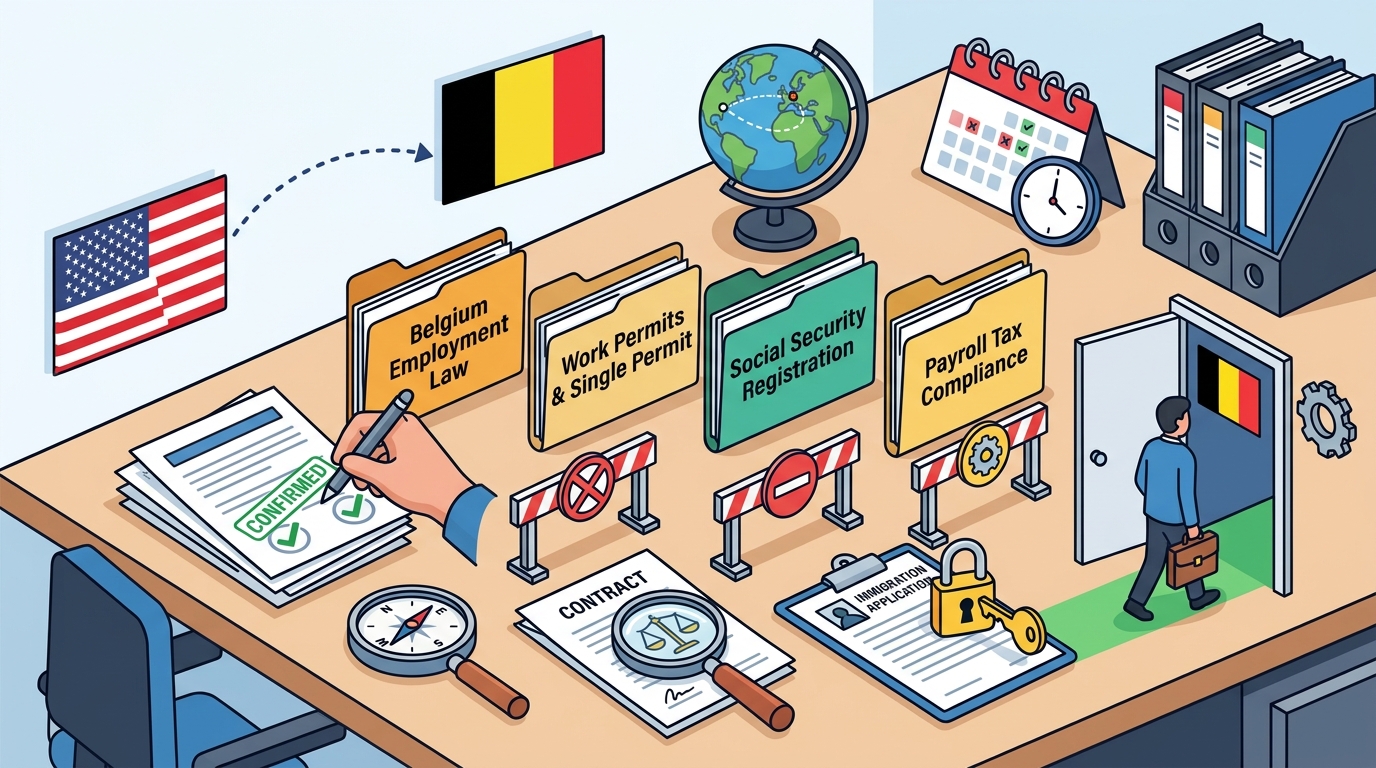
Secondment vs. Local Hire: Choosing the Right Path
Deciding between seconding an existing employee or hiring locally depends on your long-term strategy and the specific role. Below is a comparison to help you evaluate your options.
| Factor | Secondment (Temporary) | Local Hire (Permanent) |
|---|---|---|
| Legal Employer | US Parent Company (with local compliance) | Belgian Subsidiary or EOR |
| Tax Implications | Complex; potential double taxation | Standard local payroll taxes |
| Duration | Short-term (usually under 2 years) | Indefinite |
| Administrative Burden | High (requires work permit application) | Standard (local HR management) |
For international mobility, including for professional sportspeople and expatriates, careful planning is essential. We provide specialized advice on secondment of employees and expatriation to ensure your transition is smooth and legally sound.
Key Takeaways
- Legal Presence Required: You cannot hire directly in Belgium without a local entity, EOR, or compliant secondment framework.
- Single Permit Complexity: Hiring non-EU talent requires a single permit, involving labor market tests and significant processing time.
- High Social Costs: Employer social security contributions in Belgium are among the highest in Europe, impacting total compensation costs.
- GDPR is Mandatory: Employee data must be managed with strict adherence to European privacy laws, requiring regular audits.
- Contract Specificity: Belgian employment contracts are heavily regulated by Collective Bargaining Agreements (CBAs) and cannot be customized freely.
- Expert Guidance: With over 13 years of expertise, specialized legal counsel is crucial for navigating employment law and social security complexities.
Frequently Asked Questions
Can a US company hire remote workers in Belgium without a local entity?
Yes, but only through a compliant mechanism such as an Employer of Record (EOR) or a Professional Employer Organization (PEO). Direct hiring without a local legal footprint is illegal under Belgian labor law.
How long does it take to get a work permit for a non-EU employee?
The process for a single permit typically takes several months. It involves proving the unavailability of EU candidates, which can cause significant delays for urgent hiring needs.
What is the standard probation period in Belgium?
For white-collar employees, the probation period can be up to 6 months, depending on the applicable Collective Bargaining Agreement. For blue-collar workers, it is typically 14 to 30 days.
Do I need to comply with GDPR for employee data?
Absolutely. GDPR compliance is mandatory for any entity processing personal data of individuals in the EU. This includes employee records, payroll data, and performance reviews.
What are the employer social security contributions in Belgium?
Employer contributions generally range from 25% to 35% of the gross salary. These costs are in addition to the employee's salary and must be factored into your budgeting.
How do I terminate an employment contract in Belgium?
Termination is strictly regulated. It usually requires a valid reason, such as economic redundancy or serious misconduct, and often involves notice periods and severance payments calculated based on seniority and salary.
Can I second an employee from the US to Belgium?
Yes, through a secondment agreement. However, you must comply with the rules on seconded labor, obtain the necessary work permits, and manage the tax implications in both jurisdictions.
Contact Our Employment Law Experts
Navigating the complexities of Belgian employment law requires precision and deep local expertise. Whether you are looking to establish a subsidiary, hire your first local employee, or manage the termination of the employment contract on medical grounds, our team is here to guide you. We advise employers and employees on all legal aspects of employment relations and social protection.
To schedule a consultation and ensure your expansion is compliant and successful, make an appointment with our legal team today. You can also send us your question using our contact form, and we will get back to you as soon as possible.