

Which Lawyer Helps Startups Hire Foreign Workers in Belgium?
Hiring international talent is one of the biggest growth levers for startups in Belgium, but the legal path from job offer to work permit is anything but straightforward. Between the single permit procedure, EU Blue Card thresholds, and region-specific rules in Brussels, Flanders, and Wallonia, a single misstep can delay an employee's start date by months. An employment lawyer who understands both labour law and professional immigration is the missing piece most scale-ups overlook. This guide explains the legal landscape, the permit options, and why a specialised employment lawyer in Brussels is your best investment when building a cross-border team.
Why Startups Need an Immigration-Savvy Employment Lawyer
Professional immigration in Belgium sits at the intersection of employment law, social security, and administrative procedure. A startup founder who drafts a compliant employment contract but mishandles the permit application risks having the entire file rejected. An employment lawyer is a legal professional who advises employers and employees on the rules governing the working relationship, including hiring, dismissal, and regulatory compliance.
At Tine Avocat, Maître Nafissatou TINE brings 13 years of experience in employment law and social security law, helping companies manage the legal complexities of the world of work. Her dual private- and public-sector background gives her a panoramic view of the issues startups face when onboarding foreign hires.
The Single Permit: Belgium's Main Route for Non-EU Hires
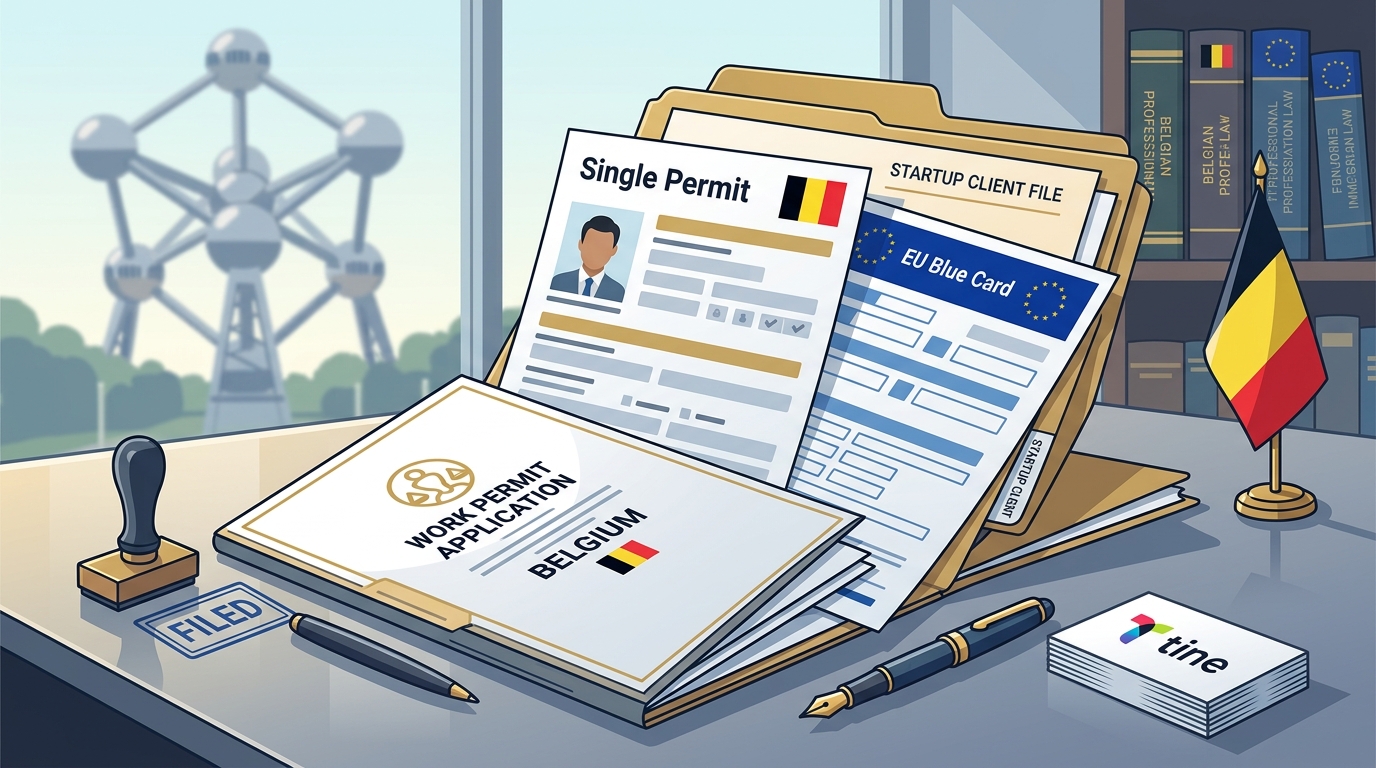
A single permit is a combined residence and work authorisation that allows a non-EEA national to live and work in Belgium for more than 90 days. Since 2019, employers must apply to the competent Region where the employee will principally work. The Region assesses the work component while the Immigration Office (IBZ) evaluates the residence component.
The New One-Stop Counter (May 2026)
Since May 4, 2026, all work-permit applications for non-European nationals must be submitted through the federal "One-Stop counter" portal. PDF forms and email submissions are no longer accepted. A lawyer ensures your dossier is complete and formatted correctly on the new platform from day one.
Processing Timeline
The standard processing window is roughly four months, though delays are common when documents are incomplete. Startups that need a developer or engineer to begin work on a specific sprint date cannot afford a rejection. Working with a lawyer who reviews every document before submission dramatically reduces the risk of refusal.
EU Blue Card: The Fast Track for Highly Skilled Talent
The EU Blue Card is a work and residence permit designed for highly qualified non-EU professionals who meet a minimum salary threshold. In the Brussels-Capital Region, the indexed 2026 threshold is approximately EUR 4,748 gross per month, according to Baker McKenzie's immigration resource hub. Blue Card holders also enjoy enhanced intra-EU mobility and can apply for EU long-term resident status after five years.
For startups competing with London or Berlin for senior engineers, the Blue Card's portability is a powerful recruitment argument. Your employment lawyer consultation can confirm whether a candidate's package meets the threshold and draft the supporting contract.
Regional Differences: Brussels, Flanders, and Wallonia
Belgium's federated structure means each Region sets its own rules for economic migration. This is a critical detail that trips up many first-time startup employers.
Brussels-Capital Region
Brussels applies a highly qualified employee threshold of EUR 3,703.44 gross per month (2025 figure, still in force as of early 2026). The region implemented its own Ordinance on economic migration on February 1, 2024, adding new compliance layers.
Flemish Region
Flanders approved new foreign-worker regulations that took effect on January 1, 2026. The policy prioritises "knowledge migration" and medium-skilled workers in shortage occupations, while excluding low-skilled labour from economic migration pathways. A EUR 200 fee now applies to combined permit applications.
Walloon Region
Wallonia sets its highly qualified threshold at EUR 53,220 gross per year (2025 amount). Since October 2025, foreign nationals pursuing self-employed activity in Wallonia no longer need to prove basic management skills.
Single Permit vs. EU Blue Card: Side-by-Side Comparison
| Criterion | Single Permit | EU Blue Card |
|---|---|---|
| Target profile | Any non-EEA employee (skilled or medium-skilled) | Highly qualified professionals only |
| Minimum salary (Brussels, 2026) | Varies by category | ~EUR 4,748 gross/month |
| Duration | Up to the length of the employment contract (renewable) | Up to 4 years (renewable) |
| Intra-EU mobility | No | Yes, after 12 months |
| Path to long-term residence | Standard rules | 5 years EU-wide (min. 2 in Belgium) |
| Application portal (2026) | One-Stop counter | One-Stop counter |
What an Employment Lawyer Actually Does for Your Startup
An employment lawyer does far more than fill in forms. Here is the typical scope of work when a Brussels startup hires a non-EU employee:
- Contract drafting: Ensuring the salary and benefits package meets regional thresholds and Belgian mandatory provisions.
- Permit strategy: Advising whether a single permit, EU Blue Card, or exemption route is optimal.
- Document review: Verifying diplomas, translations, and legalisation requirements before submission.
- Compliance audit: Checking that your HR policies (work rules, GDPR, whistleblowing) accommodate international staff.
- Dispute resolution: Representing you before labour courts if a permit refusal or employment dispute arises.
A social compliance audit is a systematic review of an employer's adherence to labour law, social security obligations, and regulatory requirements. Having one completed before filing a permit application signals to authorities that your startup is a serious, compliant employer.
Key Takeaways
- Non-EEA nationals need a single permit or EU Blue Card to work in Belgium for more than 90 days.
- Since May 2026, all permit applications go through the federal One-Stop counter; paper and email submissions are obsolete.
- Each Belgian Region (Brussels, Flanders, Wallonia) applies its own salary thresholds and rules for economic migration.
- The EU Blue Card offers intra-EU mobility and a path to long-term residence, making it attractive for senior hires.
- Flanders' 2026 regulations focus on "knowledge migration" and exclude low-skilled economic migration.
- An employment lawyer reviews contracts, selects the right permit pathway, and prevents costly application rejections.
- Tine Avocat in Brussels combines employment law, social security, and immigration expertise under one roof.
Frequently Asked Questions
Do EU citizens need a work permit to join my Belgian startup?
No. Nationals of the European Economic Area (EU plus Norway, Iceland, and Liechtenstein) and Switzerland can work freely in Belgium without a permit.
What is the single permit in Belgium?
The single permit is a combined authorisation that certifies a non-EU national's right to both stay and work in Belgium for more than 90 days. The employer initiates the application through the competent Region.
How long does a single permit application take?
The legal processing deadline is roughly four months from submission. Incomplete files or additional document requests can extend this significantly. An employment lawyer helps avoid delays by ensuring completeness upfront.
What salary must I offer to qualify for an EU Blue Card in Brussels?
As of 2026, the indexed EU Blue Card threshold in the Brussels-Capital Region is approximately EUR 4,748 gross per month. The amount is reviewed annually.
Can I apply for a permit by email or PDF in 2026?
No. Since May 4, 2026, all applications must be submitted via the federal One-Stop counter online portal. Email and PDF submissions are no longer accepted.
Which Belgian Region handles my permit application?
The application goes to the Region where the employee's principal place of work is located. If your startup office is in Brussels, the Brussels-Capital Region handles the file.
Why should a startup use a lawyer instead of handling permits internally?
A refusal delays hiring by months and can trigger compliance investigations. A specialised lawyer ensures the contract meets threshold requirements, the documentation is airtight, and the correct permit route is chosen from the start.
Does Tine Avocat handle both the employment contract and the immigration filing?
Yes. Tine Avocat covers the full cycle of the employment relationship, from contract drafting and HR policy compliance to professional immigration and labour court disputes.
Ready to Hire International Talent the Right Way?
Do not let permit complexity slow your startup's growth. Book a consultation with Maître Nafissatou TINE to map out a compliant hiring strategy for your next non-EU hire. Whether you need a single permit roadmap, EU Blue Card assessment, or a full social compliance audit, Tine Avocat delivers tailored legal support from Brussels.