

Which Lawyer Helps Startups Hire Foreign Workers in Belgium?
Hiring international talent is one of the fastest ways for a Belgian startup to scale, but immigration law is notoriously complex. From the Single Permit (permis unique) to the EU Blue Card, every route comes with regional variations, strict deadlines, and employer obligations that can derail your hiring timeline. A specialised employment lawyer bridges the gap between your growth ambitions and Belgian compliance requirements. This guide explains the permit landscape, shows you where startups typically stumble, and outlines how Tine Avocat, a Brussels-based employment law firm led by Maître Nafissatou Tine, supports scale-ups through the entire process.
Why Startups Need an Immigration Lawyer
Belgian immigration law is an employer-driven process. The company, not the worker, must submit the work authorization application before the employee applies for a visa. One missing document or late filing can delay an offer by months.
A labour law attorney is a legal professional who advises employers on hiring, contracts, and compliance with employment regulations. For startups without an in-house legal team, outsourcing this expertise is the most cost-effective approach. Tine Avocat's practice areas cover the full employment cycle, including international mobility, work permits, and secondment of employees.
Work Permit Types for Non-EU Hires in Belgium
Belgium provides several pathways for foreign nationals to obtain work authorization. The right choice depends on the worker's nationality, skill level, salary, and the planned duration of stay.
| Permit Type | Duration | Key Requirement | Best For |
|---|---|---|---|
| Single Permit (A Card) | Up to 2-3 years, renewable | Labour-market test + employment contract | Most non-EU hires staying 90+ days |
| EU Blue Card (H Card) | Up to 4 years | Recognised diploma + minimum €55,000 salary | Highly skilled workers |
| Work Permit B | Up to 12 months | Employer-specific, labour-market test | Short-term or cross-border assignments |
| ICT Permit | Up to 3 years | Intra-corporate transfer directive | Managers/specialists transferred within a group |
The Single Permit is the standard work authorization for non-EU nationals staying in Belgium over 90 days. Since January 2019, it combines both a work and residence permit into one streamlined application.
The Single Permit Application Process Step by Step
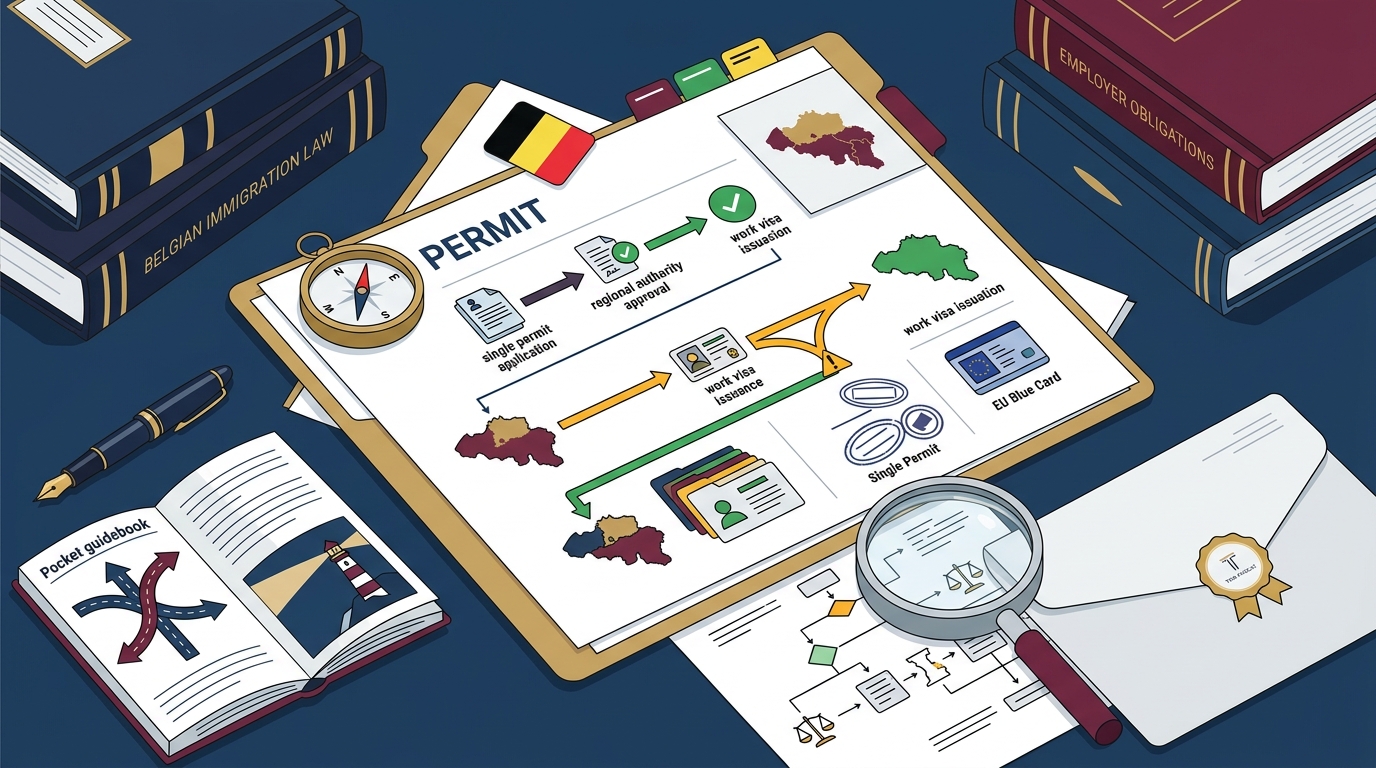
1. Employer Prepares the Dossier
The employer must demonstrate genuine economic activity and justify the role through a labour-market test, showing no suitable Belgian or EU candidate is available. Your lawyer reviews the employment contract, gathers supporting documents, and ensures the file is complete before submission.
2. Filing with the Regional Authority
The application must be submitted to the competent region based on the worker's principal place of work. Both the regional authority and the federal Immigration Office jointly process the request, with a legal decision deadline of four months once the file is deemed admissible.
3. Visa Issuance and Municipal Registration
Once approved, the worker applies for a Type D visa at the Belgian consulate, then registers at the local municipality within eight working days of arrival. Your attorney tracks every milestone and manages renewals before expiry.
Regional Differences: Brussels, Flanders, Wallonia
A regional authority is the administrative body in each Belgian region responsible for evaluating and granting work authorizations. Each region sets its own salary thresholds for the "highly qualified" exemption from the labour-market test.
| Region | Highly Qualified Salary Threshold (2025) | Application Portal |
|---|---|---|
| Brussels-Capital | €3,703.44/month | Brussels Economy and Employment |
| Flanders | €48,912/year | VDAB / Flanders website |
| Wallonia | €53,220/year | Emploi Wallonie |
Because Tine Avocat is based in Brussels, the firm has deep familiarity with the Brussels-Capital Region's procedures while also handling applications filed in Flanders and Wallonia. Explore the firm's legal interim management service if you need embedded legal support during a high-volume hiring phase.
EU Blue Card vs. Single Permit
The EU Blue Card is a residence and work permit for highly skilled non-EU workers who meet specific education and salary criteria. It offers longer validity (up to four years) and easier mobility across EU member states. However, the regional single permit is applied for much more frequently in practice because the Blue Card salary threshold is higher and it cannot be granted to seconded employees.
For most startups hiring developers, engineers, or product managers, the Single Permit with the highly qualified exemption is typically faster and more practical. Consult an employment lawyer to determine which route best fits your candidate's profile.
Common Mistakes Startups Make
Starting the Employee Before the Permit Arrives
Belgian law requires the work permit to be obtained prior to the start of employment. Violating this rule exposes the company to fines and jeopardises the worker's future applications.
Ignoring Renewal Deadlines
Employers must apply for permit renewals well in advance. Under the new EU Directive 2024/1233, workers who submit a renewal application must be allowed to continue working until a decision is made, but Belgium must still transpose this directive into national law.
Neglecting the Employment Contract
The contract must comply with Belgian mandatory provisions on notice periods, non-competition, and remuneration. Learn more about non-competition clause validity to avoid drafting errors that could void key protections.
Key Takeaways
- Non-EU nationals need a Single Permit or EU Blue Card to work in Belgium for more than 90 days.
- The application process is employer-driven; the company files the request with the relevant regional authority.
- Brussels, Flanders, and Wallonia each apply different salary thresholds and documentation requirements.
- The Single Permit is used far more often than the EU Blue Card due to lower salary thresholds and broader eligibility.
- Processing typically takes 8 to 16 weeks after the file is declared admissible.
- A specialised employment lawyer prevents costly errors such as premature onboarding, missed renewals, and non-compliant contracts.
- Tine Avocat in Brussels offers 13 years of employment law experience covering international mobility, contracts, and labour court litigation.
Frequently Asked Questions
Do EU/EEA citizens need a work permit in Belgium?
No. Citizens of EU/EEA countries and Switzerland benefit from freedom of movement and do not require work authorization to be employed in Belgium.
How long does the Single Permit application take?
On average, the process takes between 8 and 16 weeks once the regional authority accepts the file as admissible. The legal maximum decision period is four months.
Can a startup sponsor a foreign worker without a Belgian entity?
No. Employers must operate a registered Belgian legal entity and demonstrate genuine economic activity to sponsor foreign workers. A natural person residing in Belgium can act as a representative if mandated.
What is the minimum salary for an EU Blue Card in Belgium?
The EU Blue Card requires a gross annual salary of at least €55,000. The regional highly qualified thresholds for the Single Permit are lower, making it the preferred option for many startups.
Can the employee change employers after receiving a Single Permit?
Changing employers requires submitting a new work-permit application and passing the labour-market test again, unless the worker holds an unlimited-duration Single Permit.
What happens if the permit expires before renewal is processed?
Under the forthcoming transposition of EU Directive 2024/1233, workers who submit a timely renewal application should be allowed to keep working pending a decision. Currently, the employee must stop working if the permit lapses without a valid renewal filing.
Does Tine Avocat handle work permit applications?
Yes. Tine Avocat covers international mobility including work permits, secondment, and expatriation as part of its employment law practice.
Get Legal Support for Your Next International Hire
Hiring foreign talent should accelerate your startup, not slow it down. Whether you need a Single Permit for a first developer or an EU Blue Card for a senior executive, having a specialised lawyer on your side keeps the process on track and fully compliant.
Book a consultation with Tine Avocat to discuss your hiring plans and get a clear roadmap for your next work permit application.