

Contract vs Employment Agreement in Belgian Law: Key Differences Explained
Belgian law draws a sharp line between a general civil-law contract and an employment agreement (contrat de travail / arbeidsovereenkomst). Understanding that distinction is critical for every growing business in Belgium, because misclassifying a working relationship can trigger back-payments, social-security corrections and even criminal sanctions. In this guide, we break down the legal foundations, essential elements and practical consequences that separate ordinary contracts from employment agreements under current Belgian legislation, so you can structure your workforce with confidence.
What Is a General Contract Under Belgian Civil Law?
A contract, in Belgian civil law, is a legally binding agreement between two or more parties that creates, modifies or extinguishes obligations. Since 1 January 2023, general contract law is governed by Book 5 of the new Belgian Civil Code, which codified decades of case law while introducing innovations such as the hardship doctrine.
A civil-law contract can cover virtually any lawful object: a sale, a service, a lease or a consultancy mandate. Parties negotiate freely, and the principle of pacta sunt servanda binds them to what they agreed. No relationship of authority between the parties is required.
What Is an Employment Agreement?
An employment agreement is a specific type of bilateral contract in which an employee undertakes to perform work under the authority of an employer, who in return undertakes to pay remuneration. It is primarily governed by the Belgian Act of 3 July 1978 on Employment Contracts.
Unlike a general contract, the employment agreement triggers a comprehensive set of mandatory protections: notice periods, social-security contributions, anti-discrimination rules, paid leave and collective bargaining obligations. These protections cannot be waived, even by mutual consent of the parties.
Three Essential Elements
- Work: the employee performs tasks or services.
- Remuneration: the employer pays a wage or salary.
- Subordination: the employee works under the employer's authority.
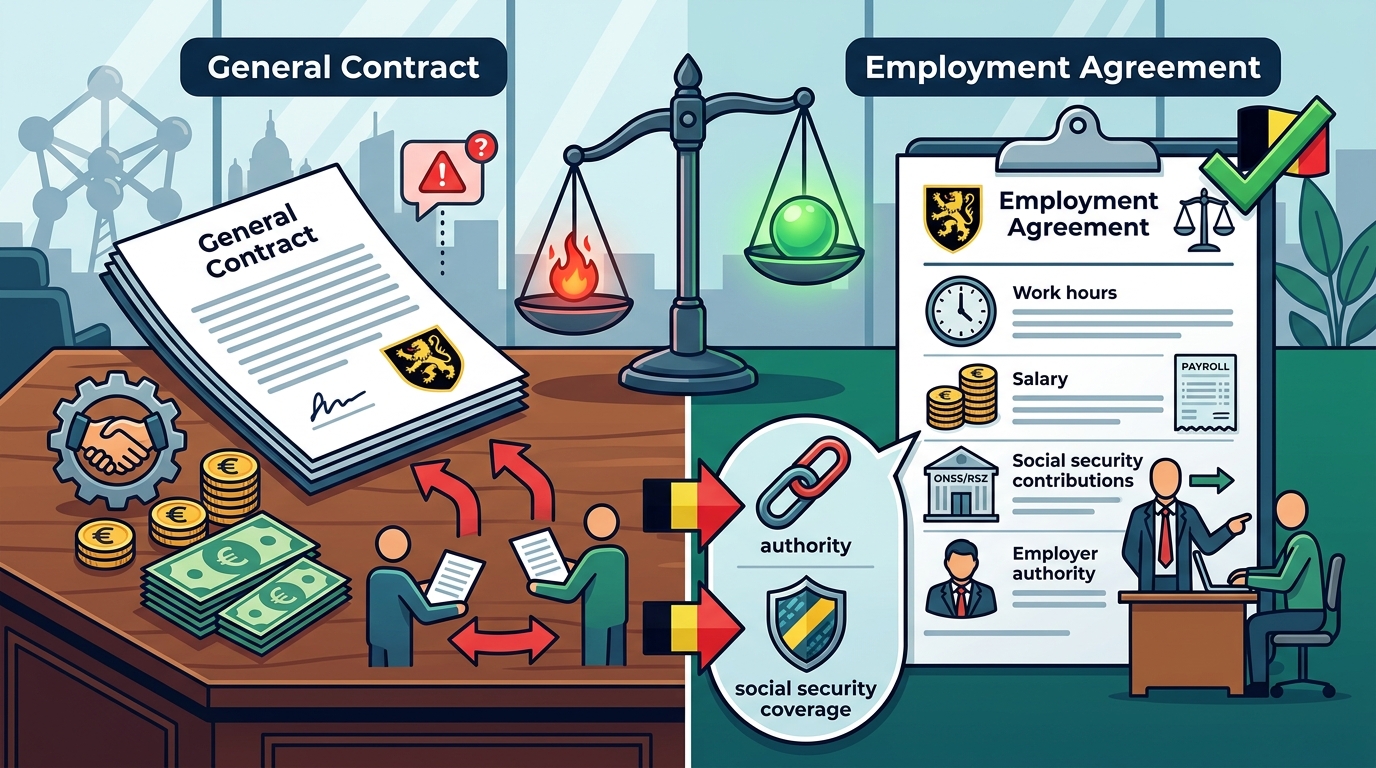
Key Differences at a Glance
| Criterion | General Civil-Law Contract | Employment Agreement |
|---|---|---|
| Governing law | Book 5, Belgian Civil Code (2023) | Act of 3 July 1978 |
| Relationship of authority | No subordination required | Subordination is essential |
| Social-security coverage | Not automatic | Mandatory employer/employee contributions |
| Termination rules | Contractual freedom (with limits) | Statutory notice periods and indemnities |
| Written form required? | Depends on contract type | Not for open-ended; mandatory for fixed-term, part-time, etc. |
| Language rules | Freedom of language (unless regulated sector) | Must use official language of the employer's region |
| Worker protections | General good-faith obligation | Extensive: dismissal protection, paid leave, CBA rights |
The Subordination Test: Why It Matters
Subordination is the single most important criterion that separates an employment agreement from any other contract. Authority includes the employer's power to give orders, supervise performance and impose disciplinary measures. It does not need to be exercised continuously; it is sufficient that the employer has the legal option to exercise it at any time.
Belgian courts and the Federal Public Service Employment use a range of criteria defined in the law on working relationships to determine whether a relationship is genuinely self-employed or, in fact, an employment relationship. If a consultancy or freelance contract is requalified as an employment agreement, the employer faces retroactive social-security contributions and potential fines.
Practical Tips to Avoid Requalification
- Ensure the independent contractor controls their own schedule and methods.
- Do not integrate the contractor into the company hierarchy.
- Review your employment law framework with a specialist before onboarding freelancers.
Form and Language Requirements
For general civil-law contracts concluded after 1 January 2023, Book 5 of the Civil Code largely preserves freedom of form. Employment agreements follow stricter rules.
When Must an Employment Agreement Be in Writing?
An open-ended, full-time employment agreement does not legally require a written document. However, fixed-term contracts, part-time contracts, replacement contracts and student contracts must be executed in writing before the start date. Without a written document, a fixed-term contract is automatically deemed open-ended.
Language Obligations
Employment contracts must be drafted in French, Dutch or German depending on the region of the employer's operating unit. In the Brussels-Capital Region, the contract must be in French or Dutch, depending on the employee's language. This requirement does not apply to most ordinary civil-law contracts, giving businesses significantly more flexibility outside the employment context.
Types of Employment Agreements in Belgium
Belgian law recognises several categories of employment agreements, distinguished by duration, worker status and nature of work:
- Open-ended contract (CDI): the default and most common form, with no predetermined end date.
- Fixed-term contract (CDD): must be in writing; successive fixed-term contracts are limited to four contracts with a minimum of three months each and a maximum total of two years.
- Specific-assignment contract: ends when the defined task is completed.
- Replacement contract: covers for an absent employee; limited to two years.
- Student contract: specific rules on working hours, social-security contributions and duration.
Choosing the correct contract type is essential for compliance with Belgian employment law. An experienced legal interim manager can audit your existing contracts to identify risks.
Key Takeaways
- A contract is any legally binding agreement; an employment agreement is a specific sub-type defined by the Act of 3 July 1978.
- The presence of subordination (employer authority) is the decisive criterion that triggers employment law protections.
- General contract law is now governed by Book 5 of the new Belgian Civil Code, in force since 1 January 2023.
- Fixed-term and part-time employment agreements must be in writing; open-ended agreements do not require written form but best practice demands it.
- Employment contracts must be drafted in the official language of the region where the employer operates.
- Misclassifying an employment relationship as a freelance contract can lead to retroactive social-security claims and penalties.
- Always seek specialised legal advice before structuring workforce arrangements.
Frequently Asked Questions
What is the main legal difference between a contract and an employment agreement in Belgium?
The main difference is subordination. An employment agreement requires the employee to work under the authority of the employer, whereas a general civil-law contract (e.g., a service or consultancy agreement) does not involve a relationship of authority.
Does an employment agreement have to be in writing under Belgian law?
Not always. An open-ended, full-time employment agreement can be verbal. However, fixed-term, part-time, replacement and student contracts must be in writing before the employee starts work.
What happens if a freelance contract is requalified as an employment agreement?
The employer may owe retroactive social-security contributions, holiday pay, and end-of-year bonuses. In serious cases, criminal sanctions for undeclared employment may also apply.
Which law governs general contracts in Belgium?
Since 1 January 2023, Book 5 (Obligations) of the new Belgian Civil Code governs general contract law. Employment agreements remain governed by the specific Act of 3 July 1978.
In which language must a Belgian employment contract be drafted?
The contract must be in the official language of the region of the employer's operating unit: Dutch in Flanders, French in Wallonia, German in the German-speaking community, and French or Dutch in Brussels depending on the employee's language.
Can I include a trial period in a Belgian employment contract?
Trial periods were abolished in 2014 for most employees. Exceptions remain for students, temporary workers and temporary agency workers. A legislative proposal under consideration in 2026 may introduce a shorter notice period during the first six months of seniority.
What types of employment agreements exist in Belgium?
Belgian law recognises open-ended contracts, fixed-term contracts, specific-assignment contracts, replacement contracts, student contracts and part-time contracts, among others. Each type has distinct formal and substantive requirements.
Where can I get legal advice on Belgian employment contracts?
A specialised employment lawyer in Brussels can review your contracts, ensure compliance with Belgian labour law and represent you before the labour courts if disputes arise.
Need Legal Guidance on Your Employment Contracts?
Whether you are drafting your first employment agreement or restructuring an entire workforce, getting the legal framework right from the start saves time, money and risk. Book a consultation with Maître Nafissatou Tine, a Brussels-based employment lawyer with 13 years of experience advising scale-ups and growing businesses on every aspect of Belgian labour law.